|
    |

Frames of Isolation: Recording Memory and Loss in Mati Diop’s In My Room
Brittany Bernard
[PDF]
Abstract
This article investigates French-Senegalese filmmaker Mati Diop’s engagement with collective and personal memory in her short documentary, In My Room (2020), made during the COVID-19 lockdowns. Drawing on Michael Renov’s notion of domestic ethnography, as well as a recontextualisation of the “home movie” as historical testimony, I argue that Diop’s framing of domestic space and its markers of personal identity bear witness to the shared memory of the pandemic. At the same time, the film addresses issues of historical trauma and diasporic experience that recur throughout Diop’s oeuvre. Echoing Chantal Akerman’s 2006 essay film Là-bas, Diop’s documentary infuses the domestic imagery of her Paris apartment with a diegetic soundscape of quotidian ambient noise, supplemented by a series of voice recordings of her grandmother, Maji, as she loses her memory before her death. In its rigorous attention to windows and framing, in combination with oral testimony, In My Room emerges as a layered cinematic mediation of memory, loss, and historical trauma.
Article
“We tell ourselves, often with incredulity, that this is where we once were. This pictured body was once the centre from which we experienced the world. And we ask ourselves how our subjective memory can be aligned with the exterior image.” (Holland 2)
In 2020—at the height of the global COVID-19 pandemic—French-Senegalese filmmaker Mati Diop made a film inside her Paris apartment. Shifting from room to room, her camera captured kaleidoscopic moments of confinement which Diop paired with audio recordings of her deceased grandmother, Maji. Entitled In My Room, Diop’s short documentary is one of the earliest artistic responses to the pandemic and emerges as a multisensory meditation on personal and collective memory, isolation, and the home movie as historical testimony. Through its fusion of poetic imagery and sound, the filmchallenges conventional methodologies of recording history and trauma, asking us to consider how the personal and mundane can bear witness to shared global crises. This article argues that In My Room reconfigures the home movie as a form of domestic ethnography that produces a politically engaged archive of pandemic experience, using framing, sound, and voice to mediate memory, loss, and historical trauma.
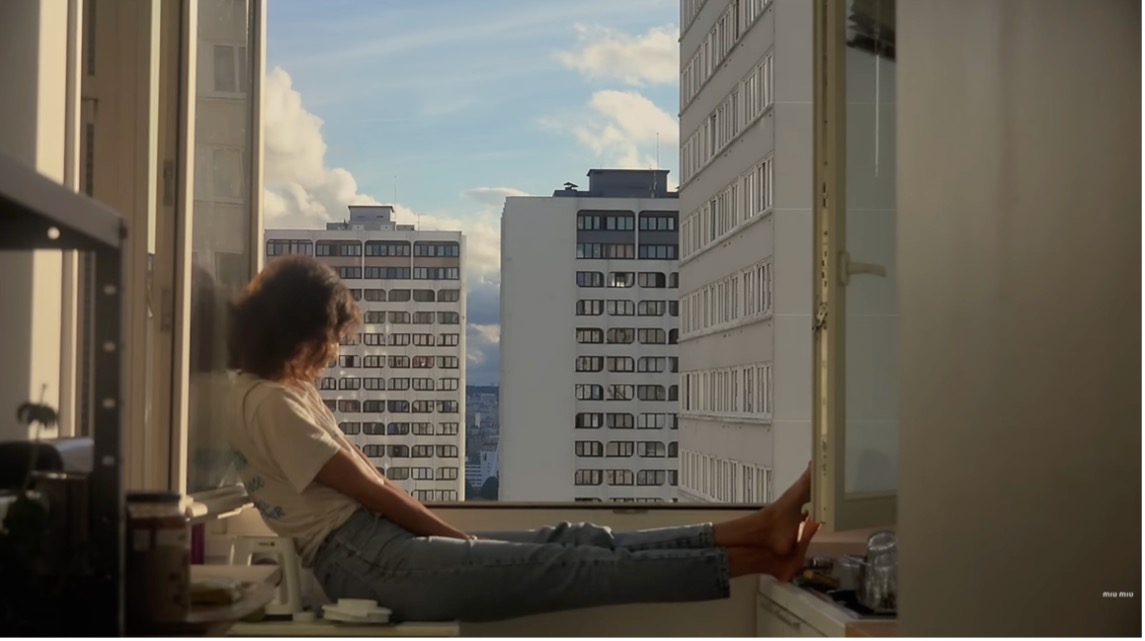
The first scene of In My Room features Diop with her back to the camera, as she opens the blinds to five oblong windows looking out to the Paris cityscape from her twenty-fourth floor apartment in the thirteenth arrondissement. Appearing in the frame, the filmmaker’s obfuscated figure invites comparison to that of Chantal Akerman in her 2006 essay film Là-bas, in which Akerman gazes out of the window of her apartment while temporarily residing in Tel Aviv. LikeAkerman’s film, In My Room is a multilayered construction of authorial subjectivity—a poetic engagement with collective and personal memory, its loss and its preservation—fluctuating between moments of clarity and obscurity.While Akerman narrates her quotidian life via an off-screen voiceover—a spectral depiction of domesticity—Maji’s recordings, too, haunt Diop’s film: her ghostly presence mirrors aspects of the COVID-19 pandemic, oscillating between real and imaginary, hope and dejection, isolation and community.
Blurring the borders between amateur and professional, the decentring lens with which Diop approaches personal and collective memories of the COVID-19 pandemic also interrogates the limits of visual representation and challenges the notion of the archive as a privileged site in the recording of history. The twentieth instalment of the “Women’s Tales” series, commissioned by the Prada-owned fashion label Miu Miu, In My Room joins a growing collection of shorts by women filmmakers, including Agnès Varda, Ava DuVernay, and Miranda July, which have garnered scholarly attention for their political engagement.[1] Despite critiques which insist on the opposition between art and luxury commerce—a notion foregrounded in the Western tradition of art as “anti-economic”—the “Women’s Tales” series reconsiders the boundaries between domains of artistic autonomy and financial obligation (Bourdieu 75). Diop’s In My Room, as it is positioned within the collective female voice of “Women’s Tales”, participates in a growing subgenre that demonstrates the cultural and political potential of filmmaking commissioned by luxury brands.
Understood within the larger context of art cinema and its reshuffling of traditional categories of genre, Diop’s film too stages an intimate encounter with the evolving relationship between art, memory, and investigations of the self through renewed modes of documentary. Constituting an example of “domestic ethnography”—what Michael Renov describes as “an extension of autobiography, a pas de deux of self and other” (229)—In My Room visually and acoustically unsettles the contours of the self and the familial other in the face of trauma. Through its fragmented discourse and destabilisation of authorial subjectivity, Diop’s short film reminds the viewer of individual and collective experiences of quarantine during the COVID-19 pandemic, while also tentatively suggesting parallels with the cognitive decline and memory loss associated with ageing.
Through a tense and often disjunctive relationship between voice and image, the spectator bears witness to both the filmmaker in quarantine and her grandmother’s earlier experience of dementia and social isolation. We join Diop as she gazes out the window from her apartment, while listening to voice recordings of Maji as she reflects on growing up in France during Nazi occupation, delights in memories of her mother’s operatic talent, and discloses frustrations with her own memory loss that has resulted in years of self-imposed isolation. As spectators, the rupture between what we see on screen and what we hear from beyond the frame renders our own subjectivity more salient; it forces us to examine our own relationship with the experience of quarantine during the pandemic, and more broadly with its entry into collective memory as a key moment in modern global history.
Using the space of her apartment as its single location, Diop’s film begs the question: how does one construct collective memory from the mundane—the routine discourse of daily life behind closed doors, sequestered in physical and psychological isolation? By juxtaposing the story of Maji as she loses her memory in the confinement of her apartment with that of mandatory lockdown during the COVID-19 pandemic, Diop’s film generates what Jim Sharpe identifies as “history from below”, one that “retains its subversive aura” and interrogates the reliability of visual documentation as evidence and truth (39). Employing an aesthetic structured around multiple frames, In My Room becomes a meditation on the ethnographic gaze, allowing us as spectators to experience the uncanny, disorientating landscape of the COVID-19 pandemic alongside the filmmaker.
Through an analysis of the framing and reframing of domestic space in Diop’s documentary, this article investigates the ways in which In My Room recalibrates our understanding of the archival and enriches methodologies for narrating historical trauma. While this short film is linked closely to the filmmaker’s autobiographical experience, its recontextualisation of amateur film or home movie as historical testimony moves it towards “committed” or politically “engaged” cinema.[2] “In fact, I had already started a home-movie,” Diop explains in a press release for the Prada Group, “with filming my confined neighbors at night, in long focal length, from the window of the 24th floor of a tower based in the 13th district of Paris.” In the hands of Diop, the fragmentary, raw, and intimate aesthetics associated with the amateur film genre are brought to bear on the representation of the pandemic, extending beyond conventional methods of recording traumatic events and their collective memory. At the same time, In My Room addresses issues of migration, displacement, and diasporic experience that run through the filmmaker’s oeuvre.
In My Room and Là-bas: The Politics of Domestic Space
Tension between authorial subjectivity and the spectator’s gaze pervades the opening scenes of In My Room. Lying next to the open window of her skyrise apartment, Diop’s body appears one with the frame, functioning as a metonym for the film’s mediation of two different zones of reality: the domestic space of the filmmaker’s apartment and the outside world. An example of what Laura Rascaroli calls “hyperframing”—which emphasises the “entrapping power of architecture”—Diop’s corporeal presence points to the film’s interrogation of invisible barriers through a cinematic framing of that which is already framed (166). A mise en abyme of windows, doorways, portals—some empty, some obscured—appears throughout In My Room, offering an architectural language for the collective experience of COVID-19’s forced isolation.
Figure 1: The director’s body as “hyperframe”. In My Room, Miu Miu, 2020. Screenshot.
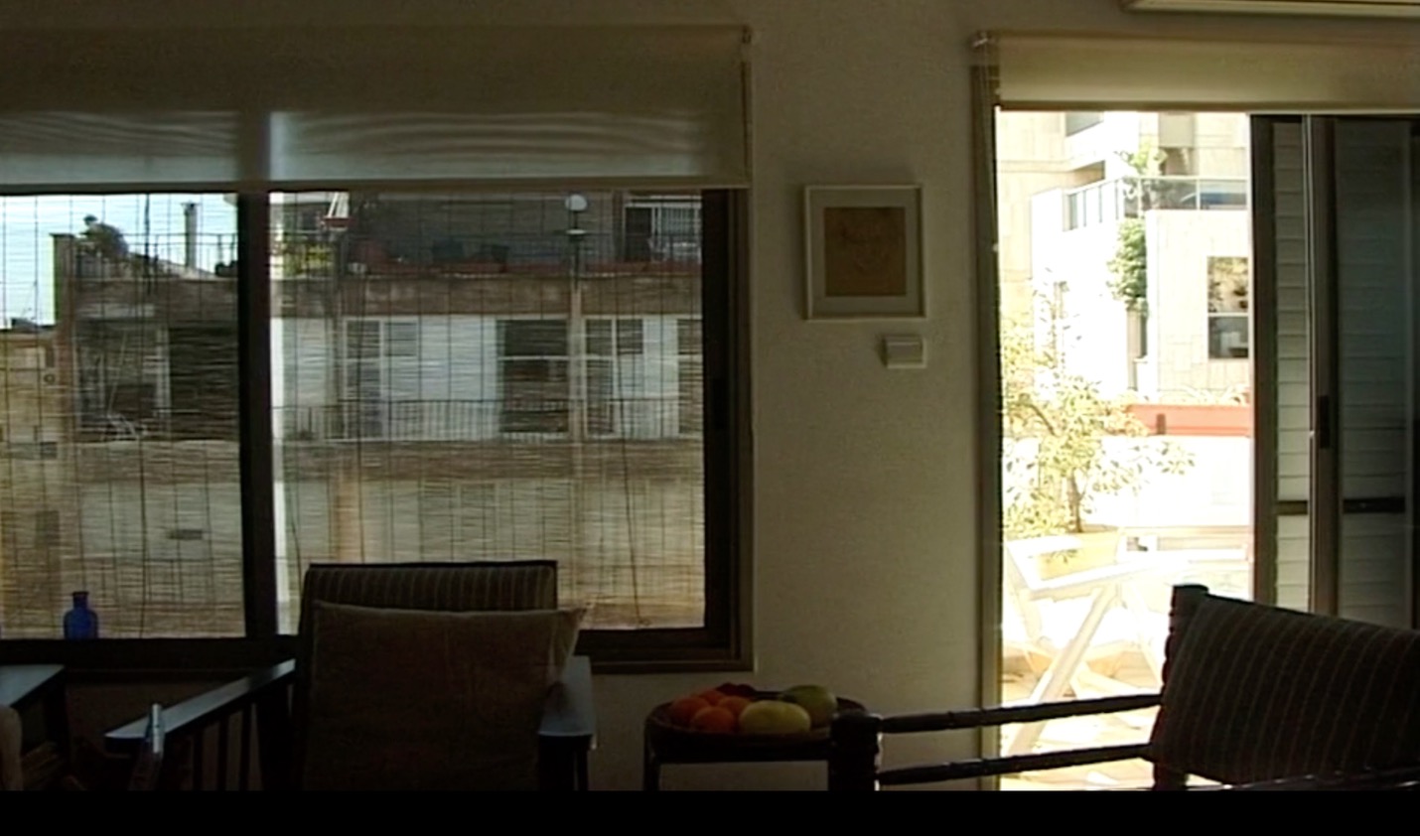
Our gaze is drawn to the open window, where the spectator’s attention conjoins with that of Diop as she looks outside her apartment toward a panoply of frames formed by the small squares of building windows. A seemingly idyllic panorama of the city: blue skies against the beige hues of Brutalist architecture, while the sumptuous clouds above offer a welcome contrast with the rigid and monolithic concrete. An audio recording of Maji, Diop’s grandmother, is heard from beyond the frame; her voice—detached from its earthly, corporeal presence—is rendered spectral. Maji (a serendipitous phonetic play on the French word, magie or “magic”) haunts the film, speaking to us from the position of what Michel Chion has famously identified as the acousmêtre. “It was quite a tough time,” Maji recalls, “it was a tough time, but we weren’t unhappy. No. We’d never known anything else.” Through the disembodied recollection of her childhood during the German occupation of Paris, a connection is drawn between the Second World War and the COVID-19 pandemic.Diop plays strategically with the ordering of space—particularly domestic space—and its relationship to the ideological norms of everyday life, familial relations, and the dialectic between public and private during a global crisis. Without direct mention of the pandemic, its traces haunt In My Room’stwenty-minute duration: the affective texture of confinement and isolation is felt in its silences, nonlinearity, and absence of direct human contact. “These strange times,” Diop writes in an email seen on screen explaining the premise of her film to Prada’s PR director, Verde Visconti—the documentary’s only reference, albeit indirectly, to the pandemic’s historic proportions. Echoing Akerman’s Là-bas, In My Room unfolds within a setting of familiar domesticity. With most scenes shot from inside the respective filmmakers’ “homes”, both Là-bas and In My Room make use of the sounds and vibrations of the city outside their windows in lieu of traditional dialogue. They feature layered soundscapes of the mundane—“sonic continuities” (Thibaud 333)—that draw on the relationship between quotidian sound and domestic space. Diegetic sounds of the city emerge from outside the windows’ thresholds, while reverberations of the filmmakers’ daily routine—footsteps on the hardwood floor, running water, and the turning of the pages of a book—penetrate the image. Both films evoke a deep sense of isolation, if not confinement. “I don’t feel like I belong, and that’s without real pain, without pride,” Akerman confides in a voiceover. “No, I’m just disconnected, from practically everything. [...] Semi-blind, semi-deaf, I float. Sometimes I sink. But not quite.” Marked by unrest and instability, Akerman’s internal dialogue parallels the state of politics in Israel at the time; specifically, the anxiety of life in Tel Aviv during the Second Intifada. Yet, from a more personal standpoint, she also bears witness to a profound mourning of her own existence, one that contemplates the legacy of the Holocaust and its unresolved trauma in her Jewish family.
Imbued with a spectral presence—one that relies on the sonic textures of everyday life—Akerman’s film creates multiple sutures between what we see on screen and what we hear through the diegetic soundscape of background noise. From beyond the frame, a soundtrack of the quotidian: the telephone rings, Akerman brushes her teeth, washes the dishes, types on her computer—together they form a cacophony of routine diversion that, as Greg Youmans writes, registers as “the video maker’s disinvestment in the camera, and by extension, in us” (80). The camera’s disregard for the spectator generates alienation, deepening the ghostly presence of Akerman herself as she narrates from beyond the frame, never showing her face.
Figure 2: Window view from Akerman’s Tel Aviv apartment. Là-bas, Paradise Films, 2006. Screenshot.
In My Room explores a similar framework of visual and sonic rupture. The disjuncture between what is seen within the frame and what is heard beyond it creates a feeling of disorientation, beginning with the windows of Diop’s apartment, where she constructs a voyeuristic panorama—moving from architectural cityscape to a surveillance of strangers’ windows. Akin to the recurring image of the ocean in Diop’s 2019 award-winning feature film Atlantique, the view from the window in In My Room becomes a central character in its own right; it figures Diop’s situated perspective, from which she experiences life during the pandemic’s mandated quarantine. By calling our attention to the processes of personal memory and its convergence with collective history, Diop’s film functions as a testimony of her individual and gendered experience, positioned within a collective reckoning of an unprecedented global catastrophe.
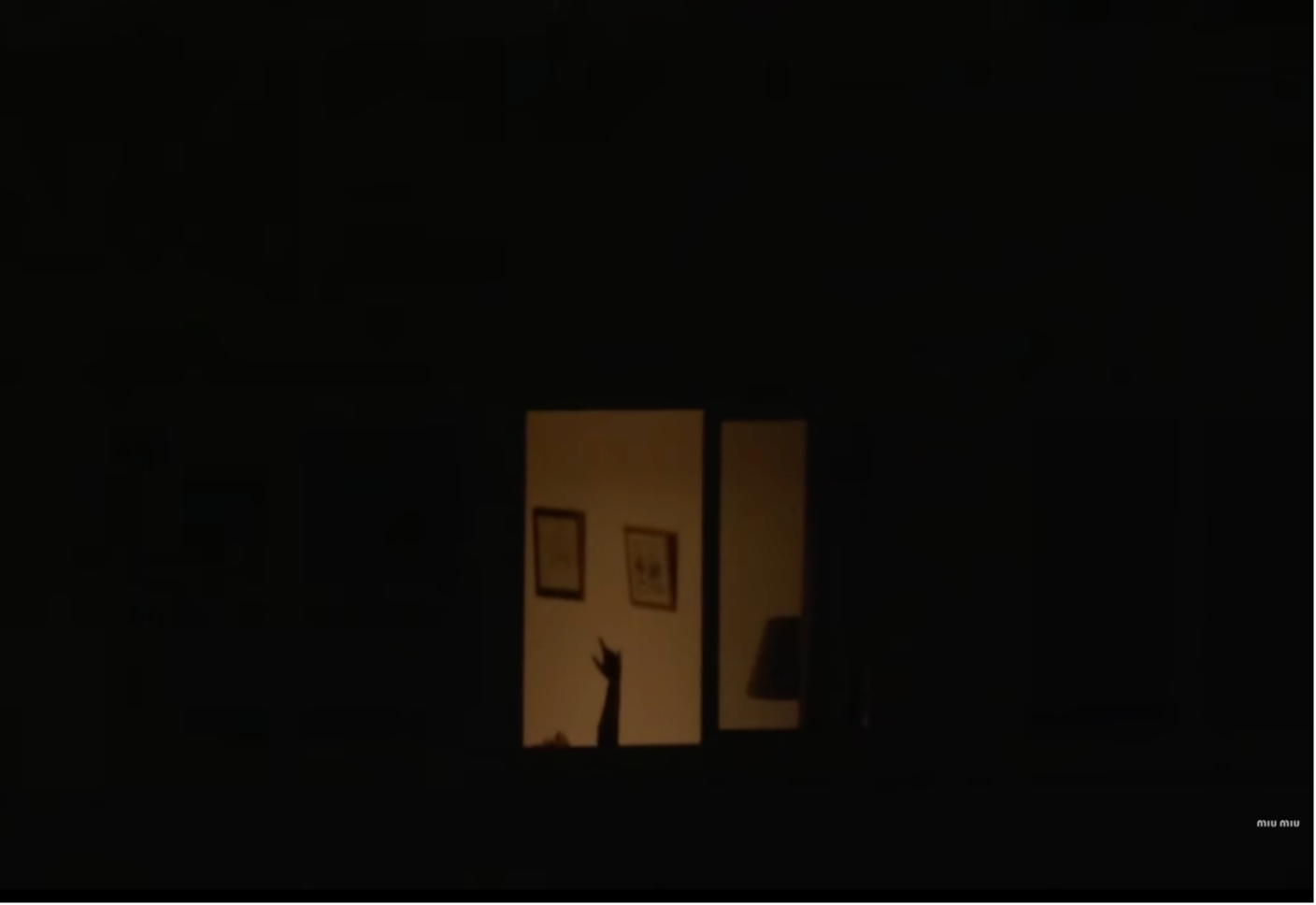
In both films, long periods of silence punctuate the voiceover, conjuring feelings of estrangement and detachment for the spectator. Symbolic and physical borders appear frequently in both filmmakers’ domestic frames, rendering the notion of “home” problematic. Although Akerman identifies as Jewish and, at the time of filming, occupies an apartment in Tel Aviv, this is not her home; she is not Israeli. “I’m first-generation Belgian,” Akerman explains in an interview with Artforum, “My mother arrived from Poland when she was ten” (Rosen). For Diop, too, there is detachment from her Paris apartment, one that becomes more salient as the camera lingers on strangers in their apartments across the city, images in which frustration and ennui with COVID-19’s mandated confinement pervade. Via this distanced, voyeuristic gaze, we observe the monotony of others in fragments: a stranger’s arm appears oddly detached from a body (echoing the zombie revenant in Diop’s Atlantique); elsewhere, a man paces around his kitchen aimlessly with a bath towel draped over his head. Despite their evocations of tedium, Diop captures domestic spaces that convey a sense of belonging: walls adorned with family photographs, house plants growing atop windowsills, and fresh fruit in bowls on kitchen counters. In contrast, the sterility of Diop’s domestic space—noticeably bare and devoid of the intimate details captured in her neighbours’ residences—highlights a more uncertain relationship to her Parisian apartment as “home”. Over these images, the compositions of British-Nigerian musician and artist, Dean Blunt—with whom she also collaborated on her most recent feature-length documentary, Dahomey (2024)—call attention to Diop’s identity as both French and Senegalese.
Figure 3: Disembodied arm. In My Room. Screenshot.
During a scene that highlights In My Room’s autobiographical modality, Diop dances in front of her bedroom mirror, dressed in an animal-print trench coat and bright red platform heels (presumably designed by Miu Miu). Beneath her, a rainbow-coloured disco ball projects refracted circles of light across the floor. The music stops abruptly, cutting to a shot of Diop sitting in the dark wearing sunglasses. She uses the flash on her iPhone to take a selfie, playing again with the aesthetics of darkness and prismatic light sources in the frame. We see her get up to scour her half-empty refrigerator, eventually settling upon a slice of cantaloupe and a bottle of wine. Through this sequence of dissociative images, In My Room makes strange the notion of “home” as familial and domestic. Like Akerman, Diop problematises associations to both comfort and belonging. Generating the impression that Diop is more akin to a “stranger” in her own home, In My Room renegotiates traditional ties between gender and domestic space, while claiming the home movie as a genre adequate to the capture of major historical events, such as the collective experience of quarantine during the COVID-19 pandemic.
Subjective Portraits: Negotiating Memory and IdentityWith a multidirectional and nonlinear approach to recalling the past, Maji’s narration jumps between multiple experiences, sometimes without coherence. She reflects on her youth before getting married at the age of twenty; the nostalgia in her voice is palpable. Her friends were actresses, she tells us, and she herself was a hostess, who—had she not got married and had there not been war—would have liked to pursue a career on stage. The irony here, as we know, is that Diop, her granddaughter, would eventually become an actor and filmmaker. As we watch Diop gaze out of the window in introspection, the scene elucidates the transgenerational, maternal filiation between the two women, underscoring Diop’s own authorial subjectivity while weaving Maji’s vocal performance into the film and making her a spectral collaborator in her granddaughter’s filmic project. Maji continues in nonlinear fashion, recalling life at ten years old during the Second World War. Once again, she takes up personal perspective on world historical events: “it wasn’t that bad, we didn’t mind.” Maji laughs, then continues: “there were dead cats on the frozen sidewalks. The war wasn’t fun, but there was cinema.” Suddenly, a weight seems lifted. Diop lets out a soft breath of agreement: a nonverbal communication of her understanding without interrupting her grandmother’s story. “And mom sang,” recalls Maji emphatically, “she was a dramatic soprano, mom. She sang everything.” In this moment, music, cinema, and the beauty of art connect the generations of women through war, through catastrophe, through the pandemic. Disparate memories, both personal and collective, constitute a rambling delirium—an exchange that although fragmented, finds meaning and coherence through moments of artistic modality, such as the overlaying of Maji’s narration with the prelude from Giuseppe Verdi’s La traviata (1853). The melody seems to bring Maji back to the present moment: “I’m too old now”, she tells her granddaughter in the recording, as they are heard conversing about the logistics of going to the Paris opera. Like the sliver of blue sky depicted in the opening scene, a fleeting moment of Maji’s mental clarity resurfaces through the reprieve of a song.
The interweaving of Diop’s identity and authorship with that of her grandmother is further emphasised by the similarity between their first names—Mati and Maji—differentiated by a single letter. Performing what Renov calls “domestic ethnography”, the pairing of the two women results in a “self-portraiture refracted through a familial Other” (216). Through an ethnographic lens on the familial, originating from a “mode of autobiographical practice that couples self-interrogation with ethnography’s concern for the lives of others”, Diop explores other themes integral to her filmic oeuvre, such as migration and African diaspora (Renov 216).[3] In blurring the subject/object positions of Maji and Mati, Diop’s filmic project provides her with a deeper understanding of her identity and family history, investigating the discrepancies and dynamics of the enunciating self. [4]
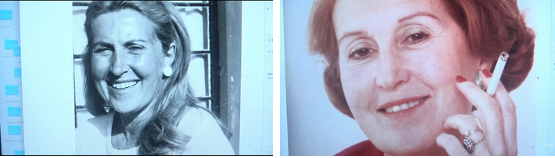
Maji’s last name, unlike Mati’s, remains absent from In My Room. It is omitted from both the film’s credits and from Diop’s email to Prada shown in the later scene. This partial obscuring of her identity is further complicated by the inclusion of two photographs shown on Diop’s laptop screen. The photos appear on screen as Maji’s voice is heard from beyond the frame, recalling, with admiration, her mother’s passion for music. The distant view of Paris shifts to an intimate close-up of Diop’s screen, where we see a cursor drag a small icon entitled “unnamed” across the desktop. The file opens to a black-and-white image of a smiling woman, her eyes closed. Her portrait appears to be cropped from a larger photograph, excluding the wider visual context of the original. Unlike a posed photograph—one identified by Catherine Zuromskis as “striving to capture an image of domestic bliss or ideal social relations”, the image of the unnamed woman may be viewed as “imperfect”, in that her eyes are caught half-closed and squinting into the sun, rather than performing for the camera (31). It is not a photograph that someone would necessarily frame for display or curate in a family album, and yet there is a gentle, happy essence about her. The image could have been taken yesterday, or could be several decades old; its temporal markings are unclear. “It’s beautiful. It’s beautiful”, Maji repeats, as La traviata’s prelude reaches a crescendo and we zoom in further on the image of the unnamed woman. Once again, Diop’s attention to framing asserts itself. Behind the photographed woman is a grid formed by windowpanes, fragmenting the image, multiplying the digital “windows” and icons seen on the computer’s screen. In contrast to the surfeit of frames on screen, the cropping of the image and the lack of contextual information compels the spectator to imagine what lies beyond it. What is the photograph not telling us? This moment, imbued with uncertainty, reflects a strategy deployed throughout In My Room, during which frames become tools of fragmentation and destabilisation of perceived truths. They introduce doubt and ambiguity, forcing us to turn our gaze and imagination towards what they exclude.
Figures 4 and 5: “Unnamed” files. In My Room. Screenshots.The camera then pans to a second photograph, this time in vibrant colour and lacking the candid quality of the previous one. In an image that resembles a “headshot”: the woman featured is once again smiling, but this time posed strategically with a cigarette in hand. We are led to wonder if these images show the same woman—Maji?—a question reinforced by the “unnamed” jpgfile icon shown on Diop’s computer screen. In the background, a voice recording of Mati and Maji plays, a fractured dialogue about whether they can go to the opera. Here, we witness Diop listen to her own voice in conversation with her late grandmother. “We can go to the opera”, Mati patiently explains to Maji, then asks: “shall we see what’s playing at the opera?” Despite her multiple attempts, Maji never responds directly to the question. The ruptures and incoherence of Maji’s memory become increasingly evident; we, as spectators, experience the destabilising delirium of memory loss alongside her.
Set against an image of a vermilion sunset, Maji’s voice recording mingles with La traviata’s haunting prelude. “We don’t have time to live”, she laments, “and we are here ...we do nothing... the days go by.” As Maji grieves the passage of time, the sound of emergency sirens outside Diop’s window ruptures what feels like a dreamlike interlude. Both Verdi’s music and Maji’s voice recording halt suddenly, thrusting the spectator back into the present moment. We return to Diop’s laptop as she composes an email about the film we are currently watching. The frame converges with the computer screen and its layers of virtual windows. Like Maji, Diop too becomes a spectral presence, registered through sound. We hear her emit a deep sigh and the rhythmic tapping of her fingers on the keyboard. The camera remains fixed on the email in real-time while Diop composes her message. She deletes and rewrites, in an allegory for the palimpsestic structure of memory. As Diop types, we partake in the conception of her film, finding ourselves present at the documentary’s origin story. Placed in front of the filmmaker’s computer screen, as if writing the email ourselves, the camera gives way to a shared experience of the present moment. “The title is IN MY ROOM”, Diop writes in all-caps, a minute detail echoed in the capitalisation of her grandmother’s name, MAJI, alluding, once again, to Maji’s spectral collaboration in the film. The camera continues to hover unsteadily over the computer screen while Diop types her own name in the email’s sign off, allowing the spectator to bear witness to the process of her authorship. Here, Diop’s self-documentation becomes not simply about the filmmaker’s “room” or even Maji’s, but rather a means of connecting her own domestic space to the collective conditions of confinement brought about by the pandemic.
Reclaiming Memory through Home Movies
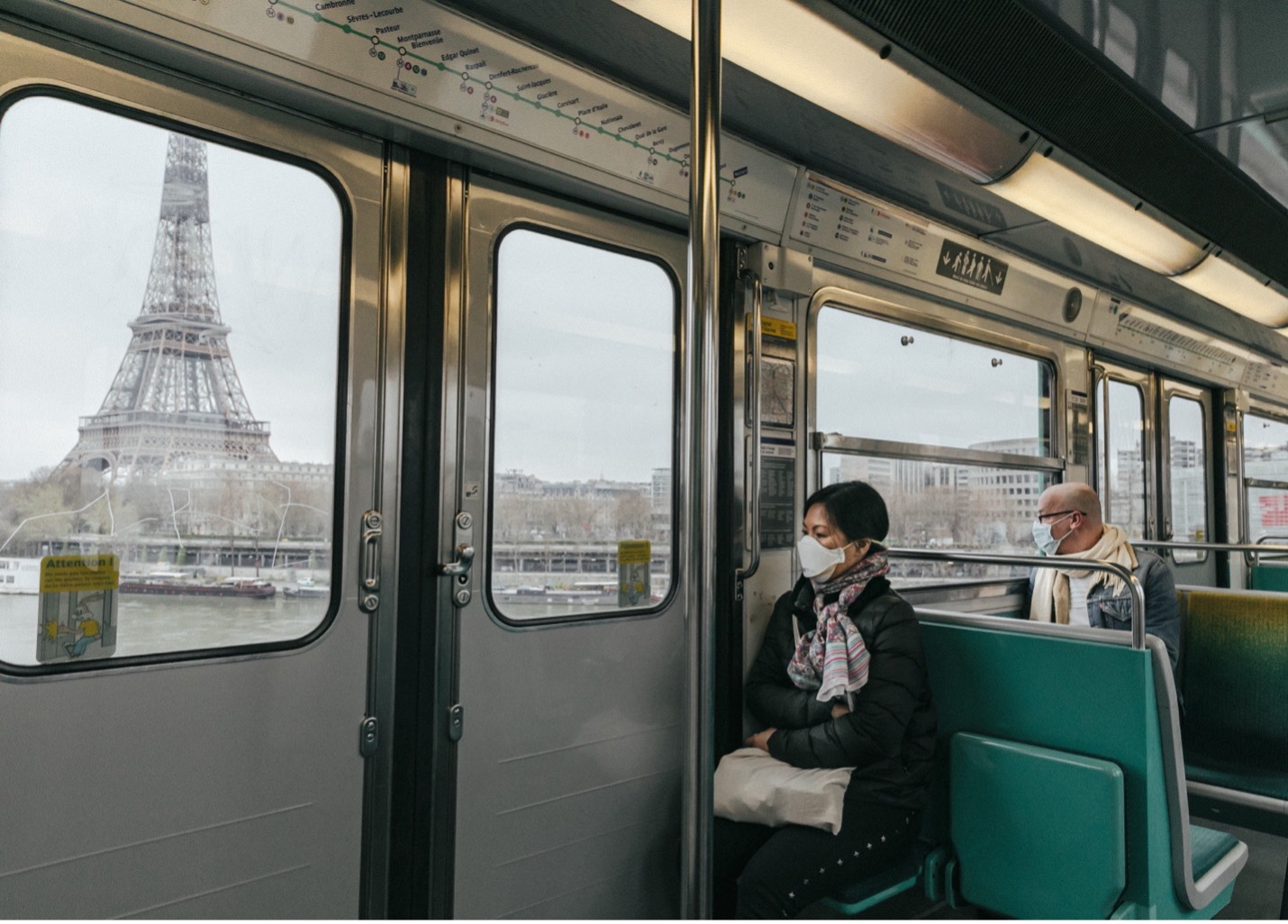
Figure 6: “The Great Empty”, Andrea Mantovani for The New York Times, 2020.
Reproduced with permission.On 23 March 2020, The New York Times published a series of photographs depicting empty city streets from around the world during mandatory lockdowns. Entitled “The Great Empty”, it was a striking depiction of a dystopian-like reality. “The view is still there, the viewers far less so”, read the caption of an image of two lone travellers on the Paris metro (Kimmelman). In what Pascal Bonitzer identifies as a “décadrage”, we are visually drawn to the fractured form of the Eiffel Tower seen beyond the train’s window. The grandeur of France’s cultural icon and its seemingly mythical status, described by Roland Barthes as “incontestable”, are put into question. “Like a rock or the river”, Barthes writes, “[the Eiffel Tower] is as literal as a phenomenon of nature whose meaning can be questioned to infinity [...] there is virtually no Parisian glance it fails to touch at some time of day” (236). And yet, in this image the Eiffel Tower seems banal when juxtaposed against the extraordinary circumstances of the COVID-19 pandemic.
The image of the Paris metro train during lockdown captures the pandemic’s destabilising of what we knew to be the mundane, routine movements of everyday life in a strategic visual framing of what Freud identified as the “uncanny”. Freud’s famous essay, published in 1919—during the aftermath of his own generation’s global pandemic—sought to unsettle inherited narratives, while confronting the paradox of what eludes us; what once felt familiar, but now feels foreign. Diop too deploys a cinematic framing of the uncanny in her documentary, where themes evocative of Freud’s concept—such as the doubling of Mati/Maji and the film’s emphasis on the spectrality of disembodied voices—give way to an ethnographic gaze, creating a sense of alienation that conjures the strange from the ordinary.
The uncanny aesthetic of Diop’s camera’s eye provides a hauntingly candid and raw depiction of reality, one that captures authentic moments rather than posed portraits. Like the Eiffel Tower in the New York Times image, the recognisable Paris skyline appears in In My Room obfuscated by other tall buildings and windows. Diop conjures the uncanny too via the image of the Eiffel Tower, present in the film only in nighttime darkness, illuminated by its twinkling lights and “searchlight”—echoing the lighthouse motif in Atlantique—thatseeks to expose other fragments of Paris’s cityscape. The searchlight reminds us of the uncanny in that it exposes what Freud described as “everything that ought to have remained secret and hidden that has come to light” (214); it troubles agreed narratives and elucidates alternative and marginalised histories.
As Patricia Zimmermann argues in the case of amateur cinema, “home movies provide memory from the inside rather than history from the outside, a narration and signification that dismantles the representation of minority cultures as victim”, placing the collective and personal happenings of those who occupy the margins of history into the centre of the frame (20). For Diop, the uncanny filmic space of her home movie also becomes an opportunity to shed light on the invisible labour of care workers during the pandemic, such as Maji’s paid carers—recognised in the voice recordings of Nabila and Amiata—who both graciously tend to Maji, despite her bouts of hostility and resistance. By including their disembodied voices in the film’s soundtrack, Diop brings representation to this vital and overlooked group, highlighting systemic issues with healthcare and its unequal distribution during a global catastrophe. The scene in which Maji experiences an outburst of anguish stands out in this regard, as it captures the emotional toll that often comes with caregiving—both waged and unwaged—as well as the acoustic power of traumatic testimony. “Leave me alone!” Maji screams at her granddaughter, while weeping loudly. Maji’s cries are heard against the visual of an empty window, calling attention to the increasing demand for care workers during the pandemic’s mandatory lockdowns.
In what Alison Landsberg identifies as “prosthetic memory”, the filmic interface given to Maji’s voice recordings during her struggles with memory loss makes it possible for the spectator to experience the trauma of Maji’s increasing isolation from both Diop’s and her grandmother’s perspectives. “Prosthetic memories are neither purely individual nor entirely collective but emerge at the interface of individual and collective experience”, writes Landsberg, suggesting the necessity of multiple subjectivities in contemporary identity politics (19). By giving representation to the trauma of ageing, memory loss, and isolation through Maji’s voice recording, Diop creates a prosthetic memory for the experience of living with dementia, while using the shared collective experience of the COVID-19’s mandatory lockdowns as a reflective mirror to this trauma so often overlooked in public memory.
Rather than emphasising the visual in the transmission of memory—as, for example, in Marianne Hirsch’s focus on the family portrait in her concept of postmemory—it is instead the recorded voice of Maji that gives rise to the effects of prosthetic memory, underscoring Diop’s strategic play with the uncanny as a means of destabilising inherited, familial narratives. Through the film’s reliance on sound and voice, the spectator of In My Room experiences a mimetic relationship to the cinematic image triggered by Maji’s traumatic testimony that—following the COVID-19 pandemic—is now closely linked to our own experience. By listening to Maji’s voice, we take on her prosthetic memories, ones that, evocative of the refractions of light and multiplicity of frames throughout Diop’s film, are inflected further by the spectator’s own personal subjectivities created during the pandemic’s mandated lockdowns.
Conclusion: Reframing Trauma
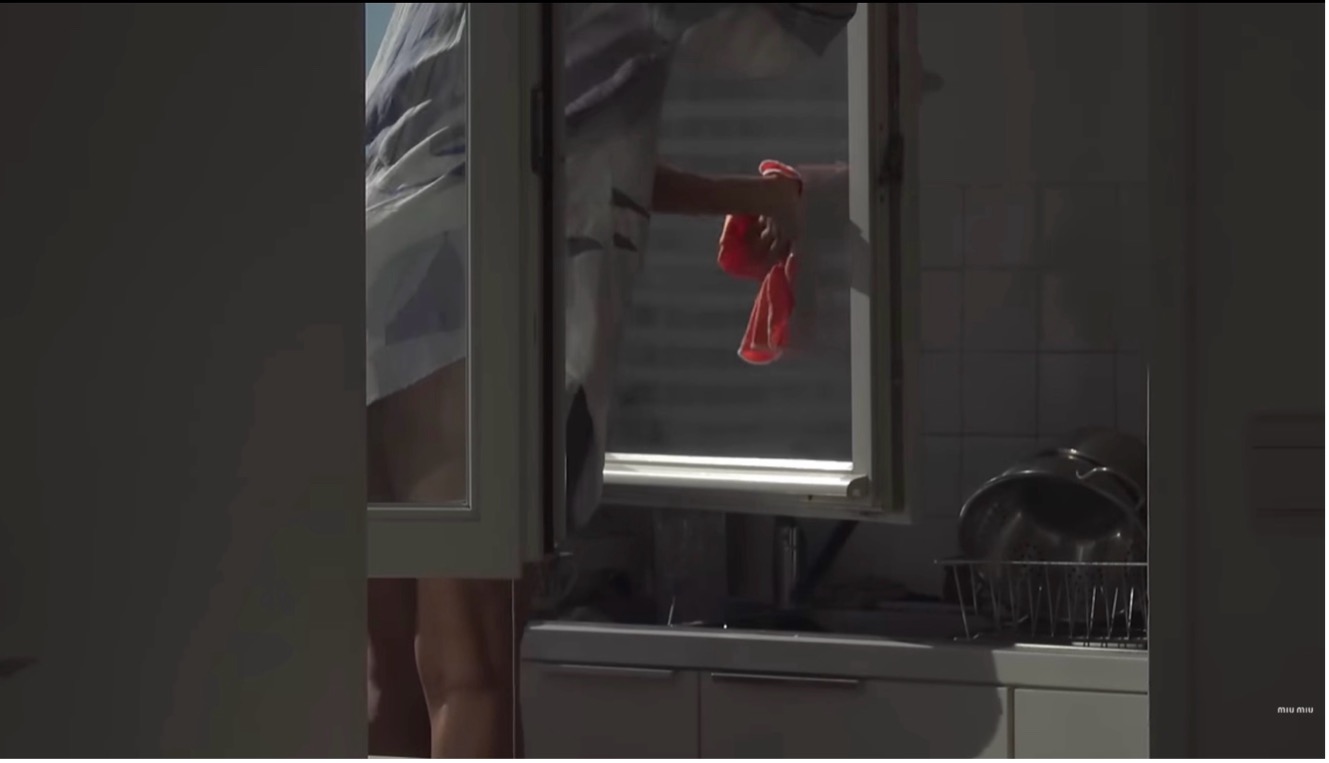
“Did she sing La traviata?” Diop asks her grandmother in one of the recordings that, until this moment, functioned more as rambling soliloquies of Maji’s recollections. “Of course”, Maji responds emphatically. Diop gasps in delight, as the sound of Verdi’s opera is heard beyond the frame. Silence is replaced by the violin crescendo of La traviata’s opening act. As Diop’s short film begins, so does Verdi’s masterpiece—one that Emilio Sala describes as evocative of the “soundscape of Paris” and notably the only one of Verdi’s operas that takes place entirely indoors (11). Diop’s film borrows both music and thematic elements from La traviata—its main character, Violetta, is a double of Maji (and Mati)—heroines who lament the life they have lost. Although its montage of eclectic images and sounds, at times, feels as fragmented as Maji’s memory, In My Room follows the arc of Verdi’s opera. It begins with La traviata’s prelude and is gradually infused with the upbeat sounds of Act I, interwoven with Blunt’s rhythmic score. For both Maji and Mati, when Verdi’s music plays, clarity and coherence are found. Obscurity gives way to light through the opening of window blinds and Diop’s almost balletic gestures as she washes the panes, paired with the triumphant orchestral swells of the nineteenth-century opera. Sound and image here offer a luminous distraction to the film’s preoccupation with tragedy.
Figure 7: Diop washes the windows with balletic gestures. In My Room. 2020.
Despite their evocation of themes rooted in historical trauma and violence, Diop’s films always end on a note of possibility. In My Room is no exception. Her filmic project as a whole functions as an overture of sorts toward what Gil Z. Hochberg, in another context, refers to as the “archival imagination”—what she proposes as “an attempt to imagine a liveable life made of new collectives yet to become: beyond the limits of national imagination […] and beyond any other ethnic, religious, national, or territorial divisions” (10). A vision for memory work that finds echoes in anamnesis; an artistic, communal, and creative archive of the present moment. “Ada, to whom the future belongs”, declares Atlantique’s latter-day Penelope from beyond the frame in the closing scene. The young heroine’s returned gaze meets ours as she proclaims: “I am Ada.” The last lines of Atlantique—hopeful, suffised with promise—seem to reverberate through In My Room’s melodic textures. Diop offers the viewer a perspective in which music, cinema, and artistic intervention within the mundane and intimate function as an antidote to the silences and obscurities of the dominant historical archive.
“But there was always cinema”, Maji declares at the beginning of Diop’s self-documentary, and perhaps she is right—perhaps it is cinema that will disseminate hope and solidarity in the uncertain political climate of our post-pandemic world. But, in the face of historical and personal trauma, is cinema’s work sufficient? Does it, as Landsberg writes in the context of prosthetic memory, enable “an unprecedented circulation of images and narratives about the past” that allows the viewer to “take on memories of events not ‘naturally’ their own” (18)? Through the lens of “domestic ethnography”, Diop’s documentary adds affective possibilities to Landsberg’s concept, involving domesticity, spectrality, and a poetics of the banal residing in the audiovisual textures of everyday life. Through In My Room’s layering of sound, music, and voice within the quotidian frame of the “home” movie, Diop offers a novel perspective on the global pandemic’s trauma—however it may be that we are experiencing it—and an alternative practice of history from the margins.
Notes[1] For an in-depth analysis of luxury brand and art collaborations, see Federica Carlotto’s 2024 sociocultural study, Luxury Brand and Art Collaborations, where she details the evolving identity of luxury brands as “cultural advisors and patrons of the arts” (3).
[2] Please consult Odile Cazenave and Patricia Célérier’s Contemporary Francophone African Writers and the Burden of Commitment (2011)for an illuminating discussion on the question of renewed forms of commitment and engagement in contemporary Francophone African literature.
[3] We see, for example, the ghostly movement of a window curtain, featured as a prominent recurring image in both Atlantique and in Diop’s most recent documentary, Dahomey, which follows the repatriation of twenty-six looted artefacts from a museum in Paris to their original home in present-day Benin. Additionally, a visual connection is drawn to Diop’s Senegalese heritage (her paternal side), notably through a personal snapshot (placed on a windowsill in front of closed blinds) of an anonymous man’s hands, his black skin framed doubly through a hole in his ripped jeans.
[4] Diop does this, too—albeit figuratively—in Atlantique with the inclusion of the character, Inspector Diop, operating as a mirror for herself as both filmmaker and archéologue of her family’s Senegalese history.
References
1. Akerman, Chantal, director. Là-bas. Paradise Films, 2006.
2. Barthes, Roland. “The Eiffel Tower.” A Barthes Reader, edited with an introduction by Susan
Sontag, Hill and Wang, 1981, pp. 236–50.3. Bonitzer, Pascal. Décadrages: Peinture et cinéma. Cahiers du cinéma, 1985.
4. Bourdieu, Pierre. The Field of Cultural Production: Essays on Art and Literature. Translated by Randal Johnson, Columbia UP, 1993.
5. Carlotto, Federica. Luxury Brand and Art Collaborations: Postmodern Consumer Culture. Routledge, 2024.
6. Cazenave, Odile, and Patricia Célérier. Contemporary Francophone African Writers and the Burden of Commitment. U of Virginia P, 2011.
7. Chion, Michel. La Voix au cinéma. Cahiers du cinéma, 1982.
8. Diop, Mati, director. Atlantique. Cinekap/Frakas Productions/Arte France Cinéma/Canal+/Les Films du Bal, 2019.
9. ——, director. Dahomey. Les Films du Bal/Fanta Sy/Arte, 2024.
10. ——, director. In My Room. Miu Miu, 2020.
11. ——. “In My Room Press Release for Miu Miu’s Women’s Tales.” Prada Group, https://www.pradagroup.com/content/dam/pradagroup/documents/2020/settembre/inglese/MiuMiuWomensTales
_20_%20IN%20MY%20ROOM%20by%20Mati%20Diop_Press%20Release.pdf. Accessed 22 Mar. 2026.12. Freud, Sigmund. The Uncanny. Translated by David McLintock, Penguin Books, 2003.
13. Hirsch, Marianne. Family Frames: Photography, Narrative, and Postmemory. Harvard UP, 1997.
14. Hochberg, Gil Z. Becoming Palestine: Toward an Archival Imagination of the Future. Duke UP, 2021.
15. Holland, Patricia. “Introduction: History, Memory and the Family Album.” Family Snaps: The Meaning of Domestic Photography, edited by Patricia Holland and Jo Spence, Virago Press, 1991, pp. 1–14.
16. Kimmelman, Michael. “The Great Empty.” The New York Times, 23 Mar. 2020. www.nytimes.com/interactive/2020/03/23/world/coronavirus-great-empty.html. Photographs by The New York Times.
17. Landsberg, Alison. Prosthetic Memory: The Transformation of American Remembrance in the Age of Mass Culture. Columbia UP, 2004.
18. Rascaroli, Laura. “No | Home | Movie: Essay Film, Architecture as Framing and the Non-house.” Film and Domestic Space: Architectures, Representations, Dispositif, edited by Stefano Baschiera and Miriam De Rosa, Edinburgh UP, 2020, pp. 154–70.
19. Renov, Michael. The Subject of Documentary. U of Minnesota P, 2004.
20. Rosen, Miriam. “In Her Own Time: An Interview with Chantal Akerman.” Artforum, vol. 42, no. 8, Apr. 2004, www.artforum.com/features/in-her-own-time-an-interview-with-chantal-akerman-168431.
21. Sala, Emilio. The Sounds of Paris in Verdi’s La traviata. Translated by Delia Casadei, Cambridge UP, 2013.
22. Sharpe, Jim. “History from Below.” New Perspectives on Historical Writing, edited by Peter Burke, Pennsylvania State UP, 2001, pp. 24–41.
23. Thibaud, Jean-Paul. “The Sonic Composition of the City.” The Auditory Culture Reader, edited by Michael Bull and Les Back, Berg Publishers, 2003, pp. 329–41.
24. Youmans, Greg. “Ghosted Documentary: Chantal Akerman’s Là-bas.” Millennium Film Journal, no. 51, 2009, pp. 70–80.
25. Zimmermann, Patricia R. “Introduction: The Home Movie Movement: Excavations, Artifacts, Minings.” Mining the Home Movie: Excavations in Histories and Memories, edited by Karen L. Ishizuka and Patricia R. Zimmermann, U of California P, 2008, pp. 1–28.
26. Zuromskis, Catherine. Snapshot Photography: The Lives of Images. The MIT Press, 2013.
Suggested Citation
Bernard, Brittany. “Frames of Isolation: Recording Memory and Loss in Mati Diop’s In My Room.” Alphaville: Journal of Film and Screen Media, no. 31, 2026, pp. 69–83. DOI: https://doi.org/10.33178/alpha.31.04
Brittany Bernard holds a PhD in French Language and Literature from Boston University (2024). Her research focuses on women’s testimony, inherited trauma, and archival absence in contemporary French and Francophone cinema and literature. She is currently developing a book project entitled Revenantes, which traces the spectral return of women’s silenced and missing voices across life writing, documentary, and fiction, from the afterlives of the Holocaust and the Algerian War to the wider postcolonial present.