|
    |

Allegories of Pandemic Governance: Comedy, Cramped Space, and National Imaginaries in European Cinema
Oliver Brett
[PDF]
Abstract
This article examines three comedy fiction films produced during the COVID-19 pandemic in different European contexts: Lockdown all’italiana (Enrico Vanzina, Italy, 2020), Stuck Together (8 Rue de l’Humanité, Dany Boon, France, 2021) and Locked Down (Doug Liman, UK, 2021). While the use of comedy was widely criticised as inappropriate to the representation of an unfolding public health crisis, this article argues that such responses overlook the films’ engagement with the political and affective conditions through which the pandemic was experienced. Drawing on Lauren Berlant’s “cruel optimism” and Gilles Deleuze and Félix Guatttari’s “cramped space”, the article explores how these texts function as allegories of pandemic governance, refracting national imaginaries of community responsibility and collective life. The formal hybridity of these films—combining comedy, fiction, and a documentary impulse—reflects the material constraints of pandemic filmmaking and the broader representational challenges of narrativising lived experience under conditions of uncertainty. Rather than offering reassurance or resolution, the films perform provisional gestures of adjustment within an impasse, revealing culturally specific attachments to sociopolitical traditions: regionalised governance in Italy, republican imaginaries of collective citizenship in France, and liberal-individualist models of responsibility in the UK. The article demonstrates the political potential of comedy and fiction as modes through which crisis, governance, and national identity may be negotiated.
Article
This article argues that three fictional comedy films produced in Italy, France, and the UK during the COVID-19 pandemic, function as allegories of their respective country’s responses. These allegories refract the national strategies of crisis management and distinct sociopolitical traditions—regionalised governance in Italy, republican imaginaries of collective citizenship in France, and liberal-individualist models of responsibility in the UK—that frame how community and responsibility are imagined. The article also argues that fiction and comedy are viable and productive aesthetic resources for negotiating the political and affective constraints of crisis and a sense of “cramped space”.
Drawing on Lauren Berlant’s “cruel optimism” (2), I demonstrate how these films stage attachment to these political imaginaries as sources of security and belonging that simultaneously constrain the possibility of radical progress and transformation. This confrontation reveals the limits of what habitually reassures us while cruelly envisioning new perspectives yet out of reach. These negotiations reflect Gille Deleuze and Félix Guattari’s concept of “cramped space” (17), a physical and/or affective condition in which expression works within the dominant language—here, including the language of comedy and fiction, and the institutions—while situating the individual as inherently political and collective within the immediacy of the pandemic. This theoretical framework reflects the proximity of these fictional narratives to the unfolding COVID-19 pandemic, and the unique documentary quality that this proximity affords them.
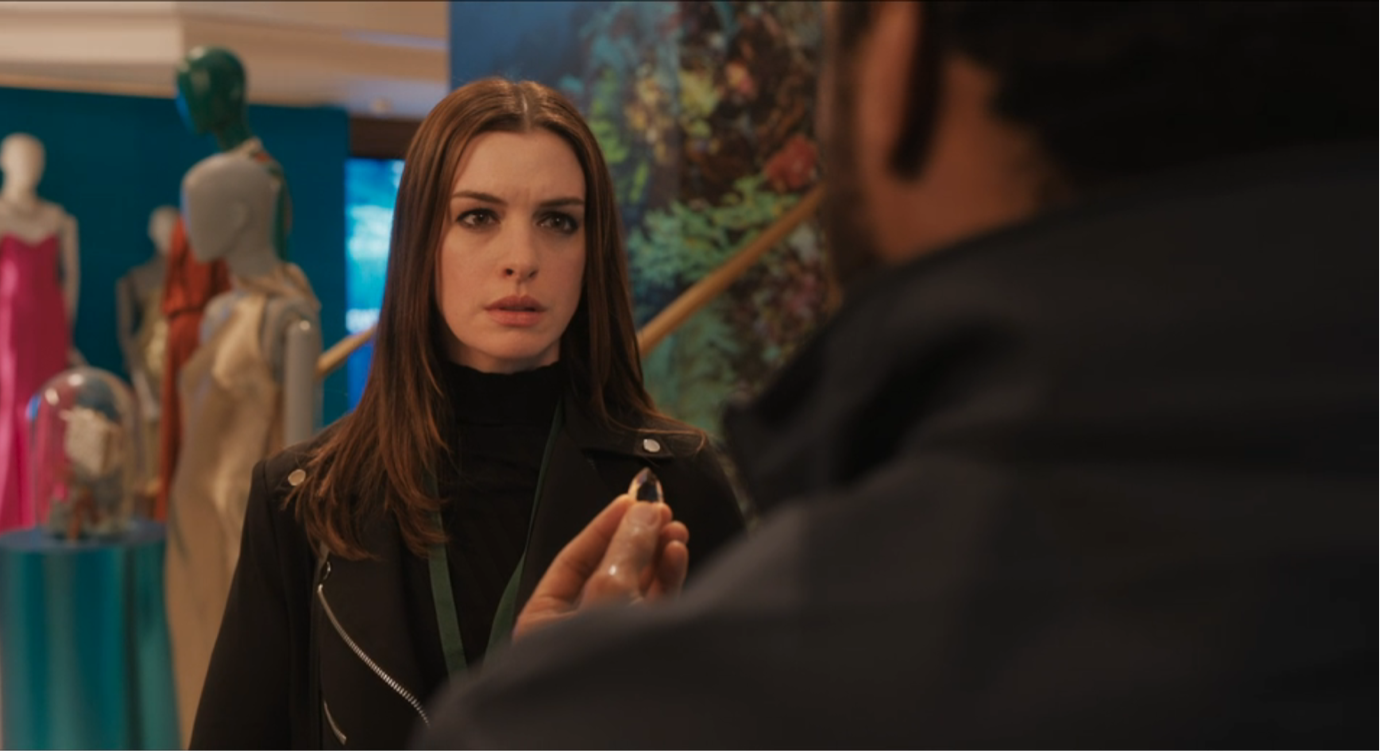
The three films forming the corpus are Enrico Vanzina’s Lockdown all’italiana (2020), Dany Boon’s Stuck Together (8 Rue de l’Humanité, 2021), and Doug Liman’s Locked Down (2021). Lockdown all’italiana is located in Rome and navigates confinement and the relationship breakdown between two married couples connected by a double affair but divided by socioeconomic inequality: the affluent Giovanni (Ezio Greggio) and Mariella (Paola Minaccioni), and the working-class and low-income pair, Walter (Ricky Memphis) and Tamara (Martina Stella). Stuck Together examines the strains of neighbourliness, solidarity, and belonging within a gentrified Parisian faubourien apartment block across a range of different tenants. Locked Down focuses on the strain of a failing marriage between CEO, Linda (Anne Hathaway), and ex-convict, Paxton (Chiwetel Ejiofor), who live in London. These films are brought together for analysis for several key reasons. They were produced with the intention of reaching broad audiences—whether through streaming platforms or theatrical release—and are predominantly framed by the comedy and fiction genres. Featuring well-known actors, they were widely regarded as overly contrived and received a largely negative critical response. Together, they nevertheless offer a productive corpus for analysis given the timing of their release and the trans-European perspective they provide on a range of social and political issues. Emerging rapidly against a backdrop of uncertainty and inconsistent messaging in diverse European contexts, these films are resourceful and responsive to “cramped space” as an all-encompassing experience in both physical and political terms. They are also a lens onto how the cultural industry responded to the overwhelming challenge of the pandemic with the materials immediately available to hand and reflect both the limits and the possibilities of narrativising crisis (Walters and Lűthi 362).
National Pandemic Responses
The rapid global circulation of COVID-19 reflects intensified patterns of mobility, and the sudden disruption it caused to everyday life through social distancing generated stress, trauma, and feelings of disconnection (Baarck, d’Hombres, and Tintori; Holaday et al.; Borgschulte and Chen). Unlike past epidemics and pandemics such as the bubonic plague, Spanish flu, and yellow fever—where the influence of uncontrolled gatherings, grain transportation, rats, and colonisers were recognised only in hindsight as significant contributory factors (Kennedy; McNeil)—COVID-19 spread at an exponential speed across highly connected populations, intensifying the sense of social and psychological dislocation. Jonathan Kennedy explains that despite successive advances in the natural sciences foregrounding the limited control humans have over natural forces, humans persist in assuming an anthropocentric worldview and overestimate their capacity to govern diseases and the environment (14). He further highlights that, overall, historical events do not unfold through human agency but through microbes and other external forces like the climate (Kennedy 292).
Although the very nature of a “pandemic” is global, national policies predominated during the COVID-19 response with individual countries reinforcing the ideal of the nation-state (i.e., instead of the global collective) and producing contrasting “territorial dynamics” (Woods et al.; Vampa 602). Davide Vampa examined France, Italy, and the UK as “case studies”, showing how pre-existing “institutional, sectoral, and political” contexts shaped their pandemic responses between March 2020 and early 2021 (603): Italy’s approach reflected the competitive autonomy of its decentralised regions; France adopted a strongly hierarchical system; and the UK is described as one of “asymmetry,” combining devolved country-specific responsibilities and a hierarchical central government (620).As the first European country to be significantly affected by the COVID-19 pandemic, Italy needed to quickly confront the inadequacies of its healthcare system when a case was identified in one of its citizens on 21 February 2020 in Codogno, in the north of the country (Indolfi and Spaccarotella). The first national lockdown had a mandated start date of 9 March 2020, early initiatives ultimately failing to control the spread of the virus as the pluralistic nature of regional governance hindered the coordination of a unified national response (Bosa et al. 9) While central government is formally in charge in Italy, constitutionally devolved legal powers at the regional level meant there was varied interpretation on COVID-19 guidance as well as in the coordination and speed of response (Capano 328). Although increasing tensions emerged between the centre and the regions over the implementation of lockdown measures—particularly in the more heavily affected area of Lombardy, the country’s economic hub and an early focus of “red zone” restrictions on movement—there was also some sharing of very good practice across regions and with central government (Capano 337; Moralli and Allegrini). Over time, the Italian government moved toward greater central coordination by integrating regional responses into a more cohesive national framework (Bosa et al. 2).
In the case of France, between January and March 2020, with the first national lockdown starting 17 March, there was a shift from a strategy of mitigation to one of suppression in managing the spread of COVID-19 (Yan 765–66). While political and government authority in France is centralised—unlike the sharing dynamics of more decentralised systems—there exists a comparatively “loose cultural orientation” among the population regarding perceptions of state intervention into everyday behaviours (Yan 766). This was clear in the continued assertion of individual and collective rights in the early stages of the outbreak and lockdown, as seen in the activities of the anti-government Gilets Jaunes (Yellow Vests) movement, the holding of the 2020 municipal elections, the congregation of 3,500 Smurfs as part of a record-breaking event, and the gathering of revellers at music festivals (Cassan and Sangnier; “Coronavirus”; Ietter; “Partout”; Yan 766;). In contrast to a “tight cultural orientation” where stronger norms surrounding social cohesion and collective responsibility tend to facilitate compliance, this looser orientation helps explain why, in the French case, a more directive decree-led approach was deemed necessary to ensure adherence to public health measures (Yan 766). The reliance on centralised authority meant that control at a local and regional level was “severely restricted” through “top-down health governance” that limited any scope or variation in management (Or et al. 16).
What was particularly distinct in the UK case was how its market-centric model ended up foregrounding existing inequalities, the pandemic proving “revelatory” of “deep-lying structures and hierarchies, which are denied or obscured during periods of stability” (Davies et al. 15). This stands in stark contrast to the cursory and overly stoic stance of former Prime Minister Boris Johnson, who stated on 13 March 2020, ten days before the first national lockdown in the UK, that the population might simply “take it on the chin, take it all in one go and allow the disease to move through the population without taking as many draconian measures” (UK Parliament). This perspective clearly underestimated the speed at which the virus could spread within a highly mobile, globalised society, and the severity of its potential impact. Drawing on Office for National Statistics data, the UK had recorded the highest COVID-19 mortality rates across all age groups by the end of June 2020, and the second highest death rate in Europe amongst those aged under 65 years by the end of the same year (Iacobucci).
The shift from the global to the national, and then ultimately to local and more immediate domestic spaces, including periods of confinement, led to increased attention to what was nearest, reassuring, and recognisable amongst the chaos. This emerged as attachments to national sovereignty and sociopolitical traditions regarding communality and collective organisation. It is important to consider how these could and should be navigated in representational terms given their potential both to foster solidarity and to reinforce exclusionary narratives.
Comedy in Pandemic Times
During a public health crisis, tensions surrounding representation become especially charged and any claims to “reality” must navigate competing demands of accuracy, reassurance, and social responsibility (Williams et al.; Wegwarth et al.). Jorge Luis Marzo explores these demands through an analysis of the visual (affective) and textual (logical) registers of public health messaging, focusing on the now iconic “Flattening the Curve” graphic which was published in The Economist in February 2020. The image condensed complex epidemiological data into a simplified visual form that encouraged compliance with behavioural interventions such as hand and respiratory hygiene, and mask-wearing. Yet, as Marzo observes, this graphic elided difference, “[minimizing] race, gender, class, geography and access to care and tests”(18) and functioned primarily as a “visible and transmissible performance of an evolving process” which sustained governmental authority in regulating life, death, and time (18, 23). Marzo adds that the image mobilised the public through “emotional pathways” rather than strictly rational or logical ones (23).
Part of a divergent body of pandemic stories, the films examined here can be read as a response to what Marzo articulates as a “state affair” where the crisis was a test of governmental legitimacy and the social contract underpinning the trust of citizens and their protection (13). Rather than reproducing the authoritative narratives of pandemic response to which they allude frequently through the familiar tropes of the period, these films unsettle the illusion of coherency by staging crisis as uneven, and unresolved, and grounded in the personal and the everyday.
An objective assessment of the potential therapeutic effect of comedy in this corpus lies beyond the scope of this article, although the affective drive of the selected films may be interpreted as indicative of such a possibility. Evidence suggests that the public actively engaged with comedy during the COVID-19 pandemic in “buffering” its impact and in retaining some degree of control and agency under unusually extreme conditions (Pabel and Turnšek; Žákovská, Maíz-Arévalo, and Cao 114). Further evidence indicates that comedy can disrupt habitual ways of thinking, particularly in relation to stigmatised epidemics (see Mulubale, Rohleder, and Squire). The renewed popularity and increased resonance during the pandemic period of Steven Soderbergh’s fictional Contagion (2011) also illustrates the affective leanings of audiences (Jabr; Marshall). Its appeal, particularly among horror fan audiences, has been linked to its capacity to support spectators in engaging with—and subsequently regulating—their anxieties within the “safe setting” of the domestic space (Scrivner et al. 5).
During the pandemic, representation and rhetoric were shaped and evaluated through multiple, often confrontational lenses, including scientific, socioeconomic, political, and moral frameworks. As a result, the relevance and perceived “appropriateness” of comedy and fiction as interpretive tools in the context of an unfolding global crisis must be considered in relation to several key factors. The comedy genre is often highly complex and reflexive, interrogating itself and the society it observes; however, the application of the label “comedy” to a given text may be reductive insofar as it obscures hybrid or mixed-genre practices therein. It has also been described as a “slippery genre” given the various formal registers it can assume (Horton and Rapf 2–4). In terms of the relationship between fictional comedy and documentary formats—the latter often positioned as a closer index of the “real”—both can be equally informative in reflecting specific contexts and situations. Fictional and documentary modes may also interweave within the same text, and comedic elements may not function merely as entertainment but as “distortions” of what is understood by audiences to lie beyond the frame, thereby foregrounding incongruities within and across different constructions of reality (Horton and Rapf 4, 20). The creative and experimental potential of comedy, precisely because of its variability, makes it particularly apt however for engaging with cramped space, as it offers a flexible point of departure when established trajectories under such conditions do not yet exist (Walters and Lűthi 362).
In considering how these three films represent the pandemic experience, the work of Berlant on cruel optimism offers a productive framework for exploring the tension between the looming promise of a resolution and the ongoing lived experience of an enduring crisis. The focus here is not on assessing whether these films adequately represent the pandemic, but on how they negotiate conditions in which established orientations have become unstable, and familiar attachments no longer provide the security they once promised. As such, the films operate as cultural documents responding to specific historical and representational demands that simultaneously expose the fragility of the attachments through which the crisis is understood.
“Cruel Optimism”
In negotiating the macro and micro dynamics of the pandemic, the directors’ recourse to comedy and fiction offered a pliable mode allowing a confrontation with a liminal space that was simultaneously tangible and intangible. In these three films, the experience of the crisis is rerouted away from abstract registers such as the global and transnational towards ordinary and proximal everyday connections and encounters linked to the national, regional, local, and domestic. The domestic sphere adopts a significant role in each of the films, as the fundamental base around which the stories unfold: the two contrasting “palazzi” (apartments) in Lockdown all’italiana; the mix of apartments in Stuck Together; and the exclusive London townhouse at 61 Portland Street in Locked Down.
The experience of lockdown in the domestic sphere was frequently described through the idiomatic “cabin fever” (or variations thereof), framing confinement as a form of “mental discomfort” centred on the “domestic threshold [as] a borderland of decisions and risk” (Crawford and Crawford 40). Such an association, however, risks binarizing space between the inside and outside, and foreclosing the possibility of confinement as a “spur to creativity” (Crawford and Crawford 4, 41). While the domestic threshold marks a physical boundary, it is also an affective space of suspension in which attachments are negotiated without being fully resolved. The films examined here navigate this liminal space, in the process imagining new ways of representing and emerging from crisis.
Berlant’s concept of cruel optimism provides the theoretical and analytical framework for a consideration of how these films narrativise the lived experience of lockdown. Cruel optimism describes attachments to “the good life”—an interdependence found in, for example, interpersonal relationships, political and institutional structures, and economic markets—that persist even when the conditions sustaining them are no longer secure (Berlant 2). In navigating this instability, various forms of adjustment in social, political, and narrative terms can be identified. Central to Berlant’s concept are the notions of the “impasse” and the “situation”: the former is a stalled temporality in which normative expectations of life and its narrativisation are suspended, the latter points to an emergent shared space of lived experience in which meaning and ways of cohabitation are sensed to be in flux (4, 6). Within this framework, attachment is understood as both enabling and constraining, surfacing out of a proximal relationality that is negotiated within conditions of precarity. The concept is used to organise the following sections, allowing for the three films to be positioned both in representational terms and as situated responses to an unfolding crisis.
“The Good Life”
Cruel optimism describes how attachment to “the good life”— which is sustained through reciprocal social, economic, and political expectations—persists even when the conditions to support it are precarious or unattainable (Berlant 2). The main idea here is that the affective optimism derived from a continued proximity to the attachment allows for the potential of something different. The affective experience of this attachment (i.e., the sense of optimism that accompanies it) may be varied and include anticipatory anxiety or hypervigilance—the key point being that the tension keeps possibility and potentiality open (2).Within the context of a threatened sense of normality, the films reflect an urgent desire to document and to preserve attachment in a way that sustains different representational and sociopolitical traditions.
The films formed part of a wider pandemic comedy response,[1] although they appear comparatively more conventional in formal terms given that these other productions primarily framed their narratives through a video-conferencing platform (i.e., Zoom or Teams). This contrast extends to what Jihoon Kim defines as “expanded documentary”, a mode of practice shaped by the proliferation of digital technologies and networked platforms in response to crises such as the COVID-19 pandemic, climate change, and migration (Kim, “Data Visualizations”).[2] The period also witnessed a proliferation in journaling practices, which included the building of various pandemic datasets for the purposes of both archival/ interpretive and potentially therapeutic functions (Willen et al.; Bibliothèque Nationale de France; Menetti; Journals of a Pandemic). Such differences point to competing attachments on how lockdown conditions might best be narrated.
The rapid development and production of all three films contemporaneously with the unfolding pandemic—and with a sense of urgency in attempting to make sense of events—reflects an attachment to filmmaking not just as a creative practice but also as an orientating device. Produced amid the socioeconomic precarity and political instability of the COVID-19 pandemic, this required directors, actors, and wider crews to sustain practice under conditions of risk while also imagining how to position audiences within an emerging “new normal”. Lockdown all’italiana and Locked Down were developed and completed were developed and completed with remarkable speed, in seven months and five months respectively, with Locked Down being filmed over just eighteen days (Soncini; Cremona; Fleming). Stuck together was filmed over six weeks following its initial conception in the earlier lockdown periods (Corteilles; Lussier).
The directors’ prominence within their respective national cinematic cultures positions these films as interventions within the public crisis, their reflections revealing a shared commitment to responding to the pandemic while the events were still being lived out. Vanzina, Boon, and Liman each brought distinct traditions of comedy, social observation, and hybrid modes of narration allowing them to engage critically with the crisis (Degroult 76–77; Robertson; “Mysteries”). Vanzina sought in Lockdown all’italiana to remain responsive and topical but acknowledged that access to resources affected his ability to obtain the usual standards of execution (Niola). For Boon, together with his wife Laurence Arné (also a comedian and actor), the personal experience of confinement, and concerns over its impact on their children, were the key triggers in considering a more hopeful and communal vision in Stuck Together (Lussier). Similarly, Liman draws attention to the complexity, in Locked Down, of capturing the essence of the pandemic, its humour hoping to function both as resistance to monotony and as a mirror for shared experience (Cremona). These factors together position these films as culturally embedded rather than as detached representations, reflecting participation and interpretation in an ongoing crisis.
The critical reception was however mixed and mostly negative: Lockdown all’italiana was accused of commodifying pandemic experience, Stuck together was faulted for being weak in social critique and relying too much on comedic tropes that ultimately failed to connect with the public, and Locked Down for its unclear genre position, uninteresting visuals, and overall bad timing (Baudin; Finos; Giuffrida; Lee; Pulcini; Winkelman). Notably in Vanzina’s case, he publicly defended his right to explore lockdown through comedy, asserting that much of the social media backlash to his production was based on a “controversial” publicity poster instead of having seen the film itself (Finos). The reception not only revealed broader anxieties surrounding the use of comedy in representing an unfolding crisis but also the extent to which these films participated in contemporary debates about the meaning and experience of the pandemic.
The unease evident in the critical reception of these films suggests that comedy may have been judged against expectations of what constituted an appropriate response to the pandemic, rather than understood as a mode emerging from—or responding to—lived experience and pandemic crisis conditions. Although comedy is frequently afforded less cultural weight than more serious forms such as news and documentary, this hierarchy is often grounded less in any intrinsic seriousness than in assumptions about realism and claims to truth (Mills 68). Under ordinary conditions, shifts in representational registers can challenge cultural authority and reflect competing claims to truth. During the COVID-19 pandemic, however, representations were also judged according to perceived intentions, and in terms of whether they appeared to trivialise or to exploit reality, and/or whether they adequately reflected collective suffering. What was at stake, therefore, was the difficulty of articulating unprecedented conditions through established aesthetic traditions that risked appearing misaligned with the moment.
As Maggie Hennefeld reminds us, “in times of crisis, genre itself falls apart, spawning hybrid mutations” (101). The instability in this shift can be challenging for contemporary audiences conditioned by what she sees as the increasing commodification of affect (105). Hennefeld argues that when hybridity is exploited in comedy film, such that the different poles of emotion are experienced, it can cause a radical shift in awareness that proves political (she refers to the renewed interest in slapstick and dark comedy as examples of this) (105). The three films reflect attachments to a range of established genres and sociopolitical traditions, which, in the context of exceptional conditions of production and reception, have generated an affective tension that supports the re-imaging of something different amid the chaos.
What critics perceived as visual or narrative simplicity, however, can be attributed less to limited artistic ambition than to constrained resources and production conditions. And, despite criticisms in relation to quality and genre choices, the three films clearly engage in the social precarity of the pandemic period, raising questions surrounding labour, employment, value, marginalisation, inclusion, and citizenship. The pandemic crisis is approached beyond the straightforward optic of resolution as a deeply affective encounter in which inequality and participation, and collective responsibilities are explored. These are seen to operate at the level of the character and through broader allegorical structures, which will be explored in more detail below.
Part of the frustration evident within the critical reception relates to the mirroring of pandemic tropes; for example, in mask wearing, smart working, the digitally mediated world, long queues and breadmaking. While this may be understood as a manifestation of “pandemic fatigue”, the reactions also emerged within a wider political climate that continued to unfold alongside the health crisis, and which was shaped by financial crisis, the rise of right-wing populism across Europe, the erosion of progressive critique, and the discursive conflation of migration and contagion. Under such conditions, representations diverging from state-sanctioned narratives of crisis management are often delegitimised (Jørgensen et al.).
The tensions evident in the production and reception of these films reveal enduring attachments both to established genre frameworks and to cultural expectations regarding appropriate forms of representation. In Berlant’s terms, these attachments reflect investment in the promises of the good life across intradiegetic and extradiegetic spaces. While traditional genre frameworks may come under strain during periods of crisis, the formal and experiential positions considered here across directors, critics, and the public, are mutually implicated and invested in seeking ways to stabilise meaning. Again, we return to this idea of the individual (whether director, critic, or the public) being both political and collective within a precarious and uncertain social and political crisis (Deleuze and Guattari 17). The resulting sense of cramped space is reflected in how these players might “fashion lives with whatever materials, languages and identities they find close at hand” (Walters and Lűthi 362), seen in the case of these films as representational adjustments and articulations of a shared impasse.
“Dramas of Adjustment”
Berlant argues that such attachments result in divergent “dramas of adjustment” as individuals attempt to navigate environments in which familiar genre and other normative frameworks no longer provide a stable means of orientation (3, 28). In this context, the promise of “normality” remains continually mediated, provisional, and under negotiation.
The films here emerged within a broader representational context in which the material conditions of production and the conventions through which stories were told had become destabilised, reshaping what could be represented and how such representations might be received. When clarity and transparency seemed most needed, the distinction between factual authority and fictional mediation became increasingly unstable. This was largely influenced by what has been termed an “infodemic”, a saturation of the media landscape with often misleading or conflicting forms of communication making it difficult to know what was reliable (World Health Organization).
As Ameline Vandenberghe claims, many pandemic narratives of the period were also driven by an eagerness “to represent and interpret the events properly”, drawing on the enduring power of storytelling as a way of responding to adversity in the absence of stable explanatory frameworks (1). This impulse was especially important in the context of a pandemic crisis framed by rapidly changing information about the COVID-19 virus, blurred boundaries between fact and fiction, and a growing distrust in official narratives (14–15).
Approaching the corpus through strict genre distinctions risks obscuring how the films actively rework representational boundaries as a response to the experience of the pandemic. As Dirk Eitzen argues, “documentary” cannot be reduced to the conventional assumption that it simply conveys a particular “truth” or advances an argument about historical reality. As he points out, some interpretations of what constitutes a documentary can in fact be “unusual and unconventional” (95), as arguably might be deemed the case here. Eitzen asserts that documentary reception begins with the heuristic question of whether a text may be “lying”, which encourages spectators to evaluate in broad terms its relationship to reality through allegory, inference, generalization, convincing argumentation, and engagement with structures of power and authority (89, 95). This position considers documentary as a mode of reception rather than as a fixed set of characteristics or generic labels, which provides a useful framework in approaching the fictional comedies examined here. Their documentary significance is not in factual representation but in how they negotiate and make sense of pandemic circumstances. The significance of these films lies in their capacity to register lived experience and the reorientation demanded by crisis rather than claiming privileged access to a documentary truth. In briefly reconsidering the documentary-fiction divide, these films can be understood as documents of crisis mediating the fluctuating affective dimensions of pandemic life.
These films position representation as a form of participation in crisis, drawing attention to a dialectical relationship with reality that, as Stella Bruzzi argues, precludes the possibility of a “pure” documentary form (5). As Bill Nichols also reminds us, documentary is always interpretive— “a fiction unlike any other”—rather than a straightforward reproduction of “reality” (6). This participation is intensified by the marked compression of temporal and epistemological distance, with the reflexive traces of production, alongside comedy and affect, articulating both the conditions of representation and the lived social and political experience of the pandemic. As such, the films narrow the gap between replication and interpretation, and between documentation and dramatization.
Interwoven into otherwise fictional narratives, the films produce a heightened sense of proximity to lived experience through elements such as direct address/breaking the fourth wall, historically recognisable moments (including original media footage of the pandemic), handheld camerawork and close-up shots, ambient sound, and intertextual references. The films also bear the material traces of accelerated pandemic production conditions, evident in restricted outdoor location shooting, the predominance of daytime filming, repeated interior spaces, use of authentic background and actors, detailed and extensive dialogue (to develop narrative space, oftentimes through metaphor) and the incorporation of live videoconferencing (again to maximise on space and time). These conditions extend beyond metacinematic formal reflexivity to encompass a general undercurrent of urgency reflected in overall production quality, which compounds a mediated sense of the “real” and a closeness to the subject-matter represented. Rather than pointing to aesthetic deficiency, however, these formal characteristics can be considered traces of crisis that collapse the distance between production and the realities being represented (i.e., they are somewhat inseparable).
Of note is also how representational control exercised through fictional strategies remained not only viable but also essential in dealing with restrictions on filmmaking practices and in creating the distance required to deal with crisis and trauma. Such conditions have since prompted scholarly activity on the capacity of filmmakers to carry out their practice in the “field”, especially in relation to constrained and/or remote production practices (Bodini et al. 19017; Yaqoub et al.). Particularly useful here is Jonathan Crewe’s experience of “embedded filmmaking” during the period of confinement, which he describes as being rooted as a “participatory agent” in a provisional site of enquiry shaped by limited resources. Instead of treating “narrative fiction” as secondary to the “real”, Crewe conceptualises it as a form of research practice and mode of critical enquiry. Drawing on his own experience of the pandemic through noir, he describes being “fascinated by […] how a parallel fiction could be used to reflect upon and respond to the lived experience of home confinement”. This perspective challenges persistent assumptions that fiction lacks seriousness as a methodological tool for exploring and understanding the world (Crewe). Although the work of Vanzina, Boon, and Liman is not explicitly framed in these terms, the dynamics at play may similarly be understood as situated forms of enquiry that resist fixed assumptions between genre and reality. Under conditions of uncertainty and constrained production resources, comedy and fiction may not therefore be seen as divergent from reality but as methodological strategies for negotiating and reconfiguring pandemic experience.
If the comedy is approached in reductive terms, it may appear trivialising and inappropriate to the representation of the pandemic. Under conditions of constrained production practices, however, the recourse to hybrid strategies appeared to offer political potential in the reconfiguring of available resources in innovative ways and in the emotional contradictions this generated. These considerations raise broader questions on what counts as knowledge, expanding the representational field and articulating lockdown experience in ways that are different to conventional and supposedly more “reliable” documentary forms (including government messaging).
“Impasse”
Berlant conceptualises the mediated, provisional, and negotiated space of cruel optimism as an impasse, an unresolved and contingent mode of lived experience in which a faltering temporality intensifies a feeling of presence and receptive awareness—”the rhythm that people can enter into while they’re dithering, tottering, bargaining, testing, or otherwise being worn out by the promises that they have attached in this world” (5, 28). The films mobilise this impasse through a sense of urgency, as introduced above, as well as through a range of tactics that disperse vision and fail to resolve a situation.
Liman makes an interesting observation when reflecting on the public’s reception of Lockdown all’italiana: “I’m really curious how it will play and resonate with an audience because what we’re doing here has never been done before. […] When else in history is there a movie where literally every single person who watches it is going to have a personal connection to the story? There’s nobody who can come to this movie and not bring their baggage. It’s just not possible” (Kelley). Liman’s observation, which is equally pertinent to the other films being examined, articulates a mode of spectatorship framed by unavoidable proximity.
With the pandemic as a persistent backdrop, alongside identifiable production constraints, the distance between representation and reality is reduced. This proximity is reinforced during the filmic encounter by a heterogenous range of genres, narrative techniques, and cultural references, none of which provide an overarching organising framework. There are points of orientation across each film in ensemble, sitcom, documentary, revenge and heist conventions, the biker and road movie, the Western, staged theatre, commedia all’italiana, shadow play, and poetry. There is also a nostalgic inflection within this heterogeneity, in the recycling of recognisable cultural references that function as pastiche, an imitative mode that highlights affinities across texts in terms of expression (Tran-Gervat 555).
Lockdown all’italiana is positioned within a diverse cinematic lineage through references to the iconic star of commedia all’italiana, Alberto Sordi, the existential crises of La terrazza (Ettore Scola, 1980), the romance and comedy of Sapore di mare (Carlo Vanzina 1983), and the themes of isolation and intimacy of Scent of a Woman (Martin Brest, 1992). Stuck Together draws on familiar traditions of French comedy through the iconic Boon, whose film Welcome to the Sticks (Bienvenue chez les Ch’tis, 2008) resonated widely across the country through its blend of comedy and regional affection (it is also France’s highest grossing film) (Degroult 76–77). This intertextuality is more directly referenced in Agate’s humorous “Pandémie” song, a social media hit which recalls the “pain de mie” (slice of bread) gaff of Problemos (Éric Judor, 2017), a much earlier popular pandemic comedy film (Riaux). In Locked Down, redemptive and heist narratives are combined with the gothic darkness and humour of Edgar Allan Poe who is referenced in framing Paxton’s increasing despondency, psychological distress and inner fears (Sequeria; Hayes 15). The biker and road movie genres are also evoked in Paxton’s fixation throughout the film on his motorbike as indicative of a happier prepandemic past.
Under crisis conditions, attachment to the familiar can function as a provisional means of orientation when other stabilising frameworks are unavailable. Unlike parody, which depends upon a recognisable target and degree of critical distance which might be difficult to achieve in a crisis defined by the unknown, pastiche offers a more flexible mode of practice through which familiar genres and styles may be assembled into provisional reflections and meanings.[3] The return within these films must be considered as one of imitation rather than as a reworking of a fixed text or form, given the unprecedented nature of the global pandemic and the absence of clear points of reference from which to interpret the unfolding events. While Lockdown all’italiana clearly evokes commedia all’italiana, the substitution of “commedia” with “lockdown” firmly locates the text in a historical moment. Similarly, the ensemble format of Stuck Together and the antiheroic and escapist features of Locked Down draw attention to the conditions of confinement and proximity that shaped the everyday experience of the pandemic. The imitation is uncertain (“dithering, tottering, bargaining, testing” (Berlant 5, 28)), reflecting the contingent and undetermined, and potentially interrelated, features of the yet to be understood pandemic experience.
This tapestry of pastiche is also shaped by the directors’ broader creative visions, each of which extends to attachments beyond the pandemic itself. Vanzina’s film centres on the pursuit of happiness in individual and collective terms, Boon’s film on the resilience of the human spirit in the face of adversity, and Liman’s film on what he describes as the “universal resonance” of a shared historical moment that also produces varied experiences (Kelley; Lussier; Spettacolomania). This openness adds to the tension between narrative coherence and fragmentation, requiring disparate elements to be assembled by the spectator at the point of reception.
The uncertainty that may result at this point is particularly notable in the nominal use of familiar narrative structures that suggest orientation, but which ultimately fail to deliver the reassurances that might usually be associated with them. In Stuck Together, while the ensemble formatsupports a looser narrative built around multiple protagonists, it privileges emotional connection over narrative resolution. Lockdown all’italiana and Locked Down draw respectively on revenge and heist conventions, although these are only lightly upheld and do not satisfactorily organise the whole narrative. All three films also invoke the wider “war” metaphor circulating at the time, a collective appeal to the national that supposedly sought to mobilise action and to shield society psychologically from the disease and its profound effects (Manzione). This is reflected in Giovanni’s “guerra civile” (civil war) statement (a deflective response to his philandering antics), Macron’s “nous sommes en guerre” (we are at war) address to the nation on 17 March 2020, and the heist framing of Paxton and Linda’s (good over evil). The “war” was far from won at the time of the films’ production, and although the metaphor suggests eventual triumph over the crisis, it functions primarily as an attachment to the prospect of restored social cohesion and stability within a fragmented space framed by competing perspectives.
While some of these narrative strategies hint at totality and resolution, the guarded optimism and open-ended orientations that characterise the concluding sequences reinforce the persistence of attachments that are no longer reliable in providing the reassurance they once did. This is evident in Lockdown all’italiana through Mariella’s continued investment in the bella figura, an attachment that she begins to relinquish as she carefully considers her revenge; in Stuck Together where the fragility of institutional authority gives way to an emerging communality; and in Locked Down, through the rekindling of intimacy between Paxton and Linda,whose relationship has hitherto been shaped by the demands of neoliberal life. In remaining incomplete, however, these adjustments reiterate the impasse in which any potential new orientations are yet to be fully established.
Helpful here in thinking about how the directors might be attempting to position the spectator and to stabilise meaning in times of crisis, is Giacomo Boitani’s focus on “openness”—outlined in his analysis of connections between neorealism and commedia all’italiana—which suggests that realism and a plural vision emerge from context and not from the construction and manipulation of various fragments into a coherent ideological or rhetorical position. Boitani offers an interesting perspective that any continuities in genre traditions are likely rooted in a shared commitment to engaging with the nation’s prevailing concerns at a specific moment in history. What differs, are the respective issues and themes affecting society and the forms of response they elicit. The response—or, as Boitani refers to it, the “tone”—changes and not specifically the resources of filmmaking practice that continue to centre on social critique. If it was satire that shaped commedia all’italiana in its response to the overwhelming consumerism of the postwar period, and the perceived threats that this brought to tradition, then the tone of the pandemic texts considered here is one of affective uncertainty and adjustment. This tone is demonstrated most obviously through the varied critical and public reception the films received, and in their largely heterogenous styles and open-endedness. Moreover, this idea of tone within the context of an acute adjustment (i.e., as above, the “dithering, tottering, bargaining, testing” (Berlant 5, 28)) suggests a documentary impulse where the realities of the pandemic and the process of representation are in dialogue.
On this point, it is worth considering the useful observation made by Owen Gleiberman in his review of Locked Down, wherein he refers to the “Soderbergh genre” to describe the film’s rapid turnaround, short production schedule, modest budget, loose genre framework, and “shot-on-the-fly” aesthetic. The comparison with Soderbergh is also productive in highlighting, across the three films, the focus on commercial-creative tensions, formal heterogeneity, recognisable social realities, nuanced characterisation and techniques that unsettle naturalised modes of viewing (Schatz xiv; De Waard and Tait 22, 28, 29). It also most significantly reflects a contemporary understanding of the “auteur” as a “discursive site” shaped by the interplay of personal experience, institutional structures, and social and historical factors (i.e., not defined by the exclusivity of the individual director) (De Waard and Tait 15). This levelling has the potential to create a productive reflexive tension between “the ‘reel’ world and the ‘real’ world” (31), an aspect reinforced by renowned directors and the inclusion of well-known figures such as Ezio Greggio, Ricky Memphis, Paola Minaccioni, and Martina Stella in one film alone (Lockdown all’italiana).
This discursive site recalls the notion of the “threshold” which was introduced at the beginning of the article. Acknowledging that engagement with this threshold (both physical and imagined) was influenced by socioeconomic privilege, the formal strategies adopted across the corpus can be seen to manipulate this boundary in a way that directly implicates the spectator in an unusual proximity to the experiences represented. This is through the oblique positioning of information technology and the human-computer interaction within the frame, which not only blurs the border between public and private spheres but also locates the spectator simultaneously as critical witness and participant. These spaces become less binarized than overlapping and continually negotiated, a key example of which is seen in Locked Down, when Guy (Ben Stiller) makes a Skype video call to Linda from his home while in the background, his son, Quinn (Quinlin Dempsey Stiller), is quietly demonstrating his discontent with the relocation to rural Vermont. The spectator is essentially privy to tensions that are only partially perceptible to the characters, appreciating of course that this is also not possible given the overall formal reflexivity of the films. There are other examples of this dynamic elsewhere within the corpus: Basile’s father bodybuilding behind him during an online lesson; Sam’s fitness YouTube persona displacing Agathe outside the frame of his mediated image; Giovanni’s flirtations downstairs with Monica while Mariella seeks support online from her friend, Veronica (at one point prompting a direct address from her to the spectator saying he is a “stronzo” (asshole)). The significance of these scenes is in how they position the spectator within the impasse, drawing them into a space of overlapping perspectives framed by partial knowledge and unresolved tensions on how to represent and to articulate this crisis experience. The threshold between representation and lived experience cannot be sustained, producing a mode of spectatorship shaped by proximity and negotiation rather than resolution.
“Shared Historical Present”
It is within this unstable and collective experience of space and time that a “shared historical present” emerges, one which is grounded in lived and affective experience (Berlant 4). This is a political space in which the competing pressures of crisis are prioritised and collective life reimagined. The focus here is very much on the present and navigating uncertain conditions (4). Berlant goes on to develop her notion of impasse further through the “situation”, which she defines as “a genre of social time and practice in which a relation of persons and worlds is sensed to be changing but the rules for habitation and the genres of storytelling about it are unstable, in chaos” (6).
While the pandemic was experienced as a shared historical present, there was little consensus on what this meant at the time and how this would or could ultimately be registered. Across the three countries represented in the selected films, distinct imaginaries of collective life are seen to emerge. In progressing through each of the films, socially and politically charged distinctions become clear. Attachments associated with regionalised governance in Italy, republican imaginaries of collective citizenship in France, and liberal-individualist models of responsibility in the UK, shape the way in which cruel optimism is represented. The analysis that follows demonstrates how these allegories refract the national strategies of crisis management alongside the sociopolitical traditions through which community and responsibility are imagined.
Decentring the Centre – Lockdown all’italiana
Counter to intense criticism, Vanzina asserts that it was not his intention to offend and that beyond all the noise surrounding Lockdown all’italiana, it is indeed a very respectful film (Spettacolomania). He further asserts that it pays homage to the “vera Italia” (real Italy) that he knows, but one which is also changing (Spettacolomania). Part of this Italy is the strong attachment to the region, which, as introduced above, played a significant role in the overall pandemic response. As progress was sought to manage the crisis through the interconnecting dynamics of centre (State) and periphery (region), a mutuality emerged highlighting that which connects and sustains, rather than which separates and divides. Within this, there was a competitiveness both horizontally and vertically with many regions negotiating the best conditions for them (Vampa 610). The film refracts these dynamics, setting them up clearly at the outset before exposing the fragility of a border in which there exists a productive tension between centre and periphery where one battle sustains the other.
At the beginning of Lockdown all’italiana, a social and economic tension is quickly established between Rome’s centre and periphery; although, over the course of the film, the assumed privileges of the centre are slowly undone through the manipulation of a vertical and horizontal plane. The hierarchy between the centre and the periphery is framed explicitly from the outset, once the extramarital affair connecting the two locations is exposed. Mariella refers to Giovanni’s mistress Tamara as “la periferica” (“the peripheral”, “the marginal”), imagining her contemptuously with hair extensions, covered in tattoos, and calling her husband “amò” (Roman colloquialism for “amore”). In Mariella’s imagination, Giovanni has chosen a “Torpigna”—a woman from Tor Pignattara, working-class, suburban Rome—over a regina, a queen. This position of privilege is reinforced through the rooftop terrace of Giovanni and Mariella’s apartment in the upscale Piazza di Spagna area, although the editing of the opening sequence appears to indicate that it overlooks the monumental and civic Piazza Venezia. The panoramic view it affords however symbolises surveillance, visibility, and connection while the simplicity and intimacy of Walter and Tamara’s apartment in the Eastern outskirts symbolise utility and constraint in social and economic terms.
The horizontal aspect of the centre is complemented by a vertical sphere of mobility and influence. Giovanni encounters his next sexual conquest on the landing below with the Airbnb tenants, Monica and Bianca, and grants permission to Monica to sunbathe on the rooftop terrace. Mariella seeks out legitimate reasons to leave the domestic space and is seen one day in the communal stairwell returning with a soft toy dog gifted to her by her friend Veronica—his need for exercise, she now asserts, will provide a valid reason for leaving the apartment. She also accesses over-priced PPE on the black market and is preoccupied with the closure of Gucci shopping outlets and hairdressing salons, and how she will manage without her domestic helper, “Happy”. The ascent and descent evident in the centre are literal and symbolic, and represented through the stairwell as a transitory non-lieu of negotiation between the restricted spaces of the private and the public (Augé 77–78).
Freedom of movement between domestic and wider social spaces is based therefore on financial flexibility and social status, those with economic and social capital retaining the ability to cross thresholds and to authorise the access of others to opportunities. While the horizontal aspect of the periphery allows increased levels of external mobility framed by labour, service, and risk—Walter as taxi driver and Tamara as supermarket cashier—the constrained feeling of this location is epitomised during a scene in which a hand-held camera circles closely around the couple as they discuss their troubled relationship and finances, which captures the emotional intensity of betrayal and economic hardship.
The fragility of the distinctions between centre and periphery, and across the film’s vertical axis, emerges though through a series of mirrored relationships connecting the two “palazzi” (apartment blocks). The lockdown transgressions of Giovanni and Tamara provide the most obvious connection across the social divide, but the film also constructs more subtle links. In each apartment block in which the respective couples live, there is a charismatic bumbling lawyer occupying the uppermost apartment—although one is straight (Giovanni) and the other is gay (Persichetti)—while Mariella and Tamara are shown simultaneously watching the same television programmes, which suggests a shared cultural experience across class divisions.
There is a recognition that boundaries are potentially porous too. Mariella’s hypervigilance about the virus attaching itself to superficial surfaces allows her to draw an analogy between Tamara as contaminant and Giovanni as especially shallow and vulnerable to her effect. Mariella’s fear of contamination extends beyond the biological and physiological to the bella figura of what she has sustained through inherited privilege, her aunt having bequeathed the apartment to her. This fragile sense of unity within the centre is reflected in the scene where she caresses the Italian tricolour on her balcony while pondering a return to normality and social order.
Alongside the mirroring and porousness, there is also a sense that difference does not simultaneously preclude solidarity or connection. When Mariella first encounters Monica on the rooftop terrace, initially mistaking her for Tamara, she reveals that Giovanni is not the “cornuto” (cuckold) he claims to be. Adopting a distinctly Roman expression, Monica—a “settentrionale” (a northerner) from Bergamo—challenges him over “sta marea de cazzate” (this load of bullshit). Although her pronunciation is somewhat off the mark here, Mariella remarks that she has nonetheless captured the women’s sentiment perfectly.
The scene in which Persichetti comes to borrow some salt from Walter similarly stages a temporary dissolution of hierarchical structures. Following an initial misunderstanding between the two over formal modes of address, there is a mutual “sfogo” (venting) at the kitchen table about the state of their respective relationships during this difficult period. The temporary collapse of social distance is partially restored at the end of the scene when, as Persichetti leaves, he requests the return of his shoes—which he had been asked to remove at the doorway at Walter’s insistence upon entering the apartment. This small request reinstates ingrained class boundaries structured through service and deference, alongside the more contingent boundaries of lockdown measures and anxieties surrounding contamination.
There is also an intense intimacy at the end of this sequence when Persichetti, positioned face-on to the camera, with Walter directly behind him also face-on, admits that he is scared and very lonely when asked if he is afraid of the virus. The pause that follows renders the encounter a formative strategy within the film’s construction, suspending divisions between the centre and periphery and across both the vertical axis and the intradiegetic and extradiegetic spaces. When Walter utters “tutto andrà bene” (it will all be fine), the well-known pandemic slogan is seen to reflect the national feeling of uncertainty at a very personal level impacting all citizens.
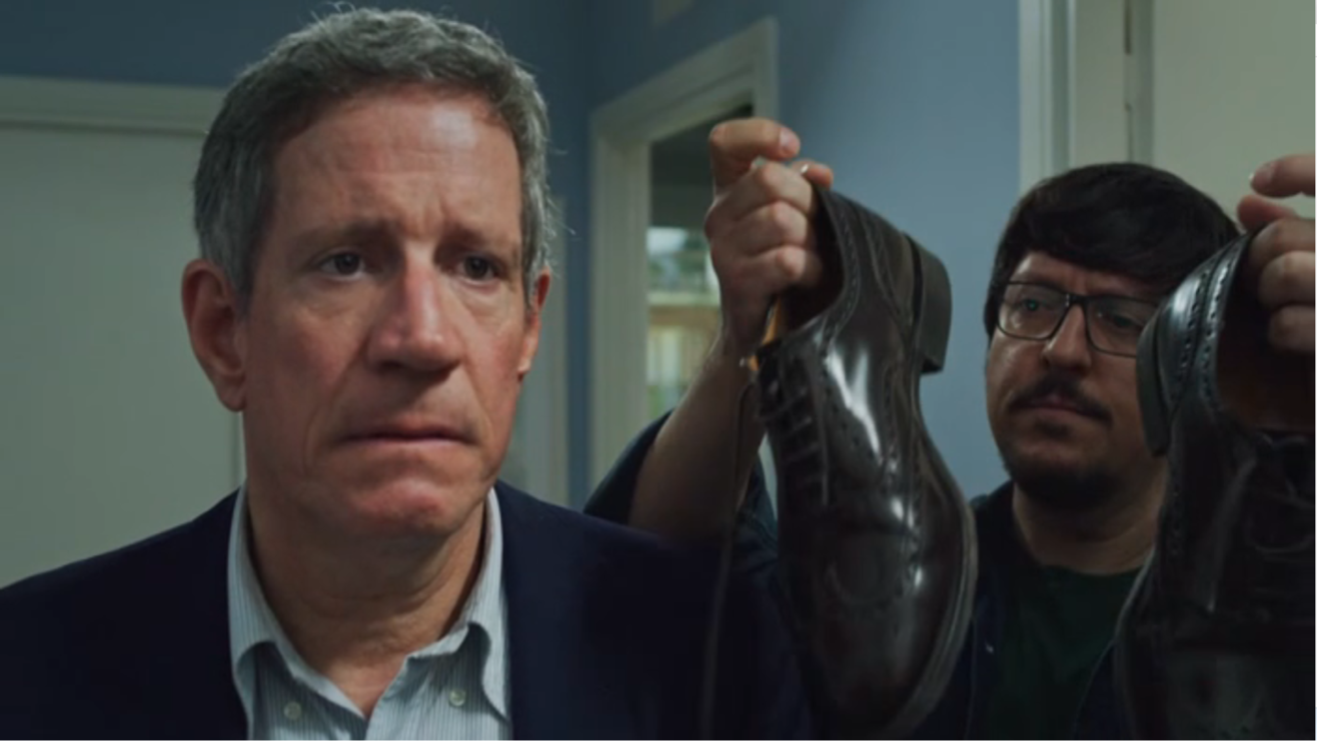
Figure 1: Persichetti requesting the return of his shoes.
Lockdown all’italiana, Enrico Vanzina, 2020. Screenshot.
Of course, the football metaphors interspersed throughout the film offer some of the clearest examples of a shared cultural language appearing to cut across space and social class, where play, contact, regulated movement, tactical positioning, competition, and ranking, are all deemed as equally strategic. These metaphors also reflect deeply embedded and shared vulnerabilities. Giovanni’s sexual impotence when in bed with Monica is likened to the improbability of a no-score draw between Atalanta BC and Juventus FC, extending notions of combat and defeat into the realms of gender and sexuality, and intimacy. Tamara and Walter defiantly reclaim their peripherality at the end of the film in declaring an ongoing stand-off with Giovanni and Mariella— in their direct address to the camera, they say “Li ‘cuciniamo’ noi questi due pupazzi, periferia batte Piazza di Spagna” (We’ll take care of these two clowns, the outskirts will beat the centre).
Across the two palazzi, characters move both laterally and vertically, crossing thresholds of risk associated with their relationships and identities, and anxieties surrounding COVID-19. The motifs of lateral and vertical movement that structure the film’s social choreography point to the fluidity and asymmetry with which privilege and power are negotiated during times of crises. Central to this reflexive positioning is the figure of the “cornuto/a” (the horned one), identified and targeted by the “fare le corna” gesture which also depends upon a vertical orientation: directed upwards, the gesture denotes infidelity; directed downwards, the gesture wards off evil and misfortune.
Giovanni’s exclamation towards the end of the film, “questo è il Palazzo dei Cornuti” (this is the palazzo of the Cuckolded/Betrayed), collapses active and passive positions of betrayal (i.e., the giving and/or receiving of “le corna” [the horns]—to betray or to be betrayed), as he realises while in conversation with Monica, again in the stairwell, that everyone in the building has in some way been deceived through infidelity. Of note is how this exchange takes place immediately after Giuseppe Conte, the Presidente del Consiglio dei Ministri, announces that restrictions will be partially eased on 4 May 2020. Giovanni’s personal reckoning therefore aligns with a moment of collective transition, the figure of the “cornuto/a” destabilising the distinction between centre and periphery as betrayal becomes the shared condition linking both palazzi. The figure of the cornuto/a, as the one blamed despite having done nothing wrong, thus reveals the injustice of misplaced blame. In the context of the COVID-19 pandemic, the film avoids assigning culpability to the individual for conditions beyond their control, instead drawing attention to the macro structures that shape and govern collective life.
However, this recognition on Giovanni’s part does not result in reconciliation as Lockdown all’italiana ultimately resists social and moral resolution. Walter and Tamara remain openly defiant at the end and Giovanni quicky returns to his old habits. In contrast, Mariella emerges as perhaps the most self-aware figure as she recognises the fragility of the privileged position she has sought to maintain. Yet, even as she prepares to hook up with the working-class Walter following an online exchange, it remains unclear whether she fully understands the web of deceit in which she is implicated, including the possibility that he is Tamara’s husband. His marginal status entices her nonetheless as part of her broader strategy of retaliation and reinvention.
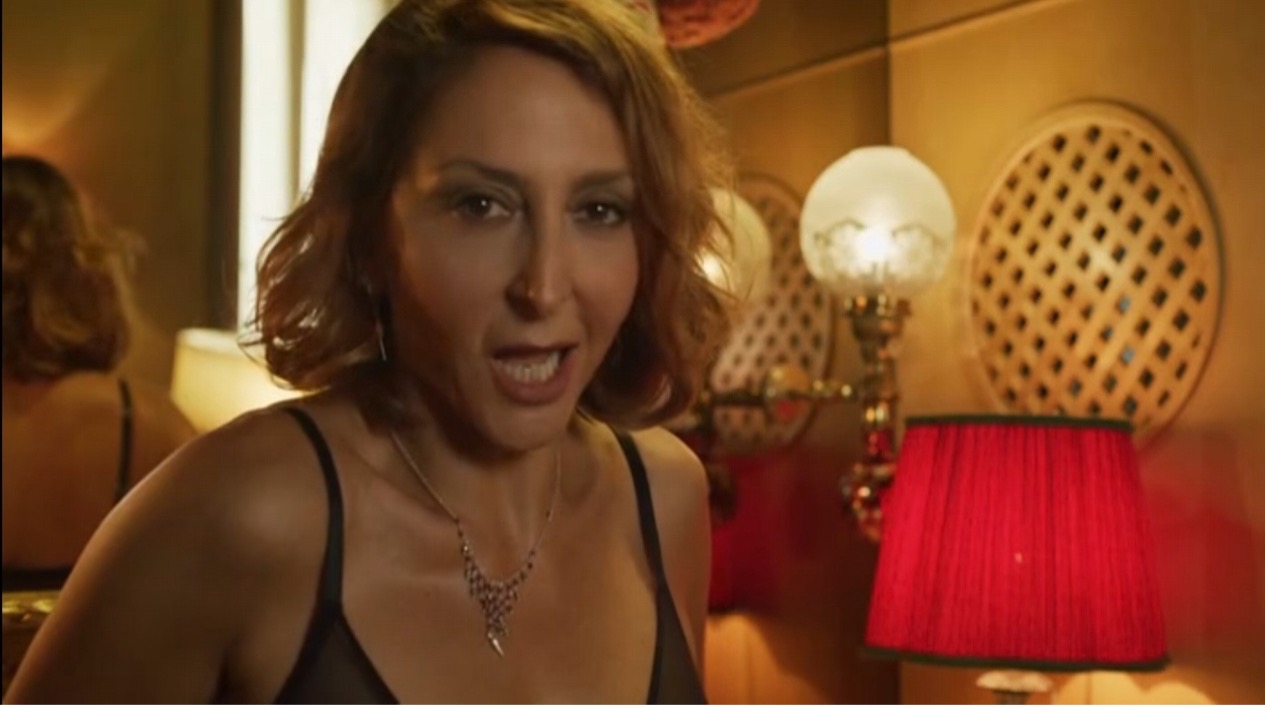
In a direct address to the spectator, she exclaims that she feels like Scarlett O’Hara, but, unlike her, she will not be waiting until tomorrow—“Boh! Io da questa tragedia ho imparato una cosa. Bisogna aprirsi al nuovo. Mi sento come Rossella O’Hara, ma io non aspetto domani. Io, da oggi, faccio una strage” (Well! I have learned one thing from this tragedy. You need to be open to new things. I feel like Scarlett O’Hara, but I can’t wait until tomorrow. Starting today, I am going to commit a massacre). Scarlett is both victim and survivor but also independent, obstinate and resistant (Taylor), so Mariella appears here to fully confront the ambivalent dynamics of the “cornuta” position. In the context of the comedic register—exaggerated through Mariella’s forceful laughter—the reference to a “massacre” suggests the betrayal is not closure or defeat but a continued struggle instead. The battles shaping the ongoing socio-economic and political patterns of the COVID-19 pandemic are set to persist.
Figure 2: Mariella as Rosella O’Hara. Lockdown all’italiana, Enrico Vanzina, 2020. Screenshot.
Mariella’s determination to continue “playing the game”, a motif established throughout the film in recurring football metaphors, reflects the film’s broader refusal of social and moral resolution, and any final confrontation relating to centre and periphery. The film closes with escalation rather than reconciliation, reflecting the open and morally ambivalent endings characteristic of commedia all’italiana film. The pandemic does not level difference but instead destabilises fixed positions across the vertical axis of privilege—including those seemingly in control of the centre. This is an important reminder of the power of the regions in sustaining the competitive force of any national crisis response from the “centre”. The movement across the different planes was similar in the French context too, recalling the initial resistance of citizens to comply with behavioural regulation at the start of the crisis, although its management was largely top-down and implemented through state decree.
Reclaiming Agency from the Bottom Up – Stuck Together
The centralised model of governance in France is visualised in the publicity image for Stuck Together, where the Eiffel Tower overlooks a series of apartment blocks whose residents signal their distress with an SOS sign. The composition evokes Michel Foucault’s “panopticon”: a system of surveillance and social control wherein the mechanism of “[seeing]/being seen” is set to homogenise and to suppress dissent (Foucault 83–84). The integrity of the “panopticon” is challenged however through exaggerated characterisation within the central narrative of Stuck Together, with figures usually associated with institutional authority being seen to undermine the roles they represent: a criminal lawyer commits acts of vandalism to a car and breaches confinement rules; a rogue former Pasteur Institute scientist conducts vaccine experiments on a guinea pig he calls Lili; a businessman makes clear that success is not dependent on academic ability or moral or ethical integrity (he notably struggles to understand the subject group of a sentence, which reiterates his self-centredness within the collective); and a scientific illustrator embodies the paradox of expertise and anxiety in his extreme hypochondria. The apartment block functions then as a kind of laboratory reflexively testing its own mode of operation within the system while implicating the position of the director at its centre (Foucault 85).
In opposition to, and gently resisting, the chaos and false certainties asserted by those who claim authority, the child figures, Basile (Milo Machado-Graner) and Louna (Rose de Kervenoaël), and the elderly restaurant owner and widow, Mme. Louise (Liliane Rovère), embody a carefree resilience born either of innocence or already knowing or having experienced too much. They foreground the limits of a republican model that lauds unity but struggles to accommodate difference or dissent at a cultural and/or behavioural level during times of crisis.
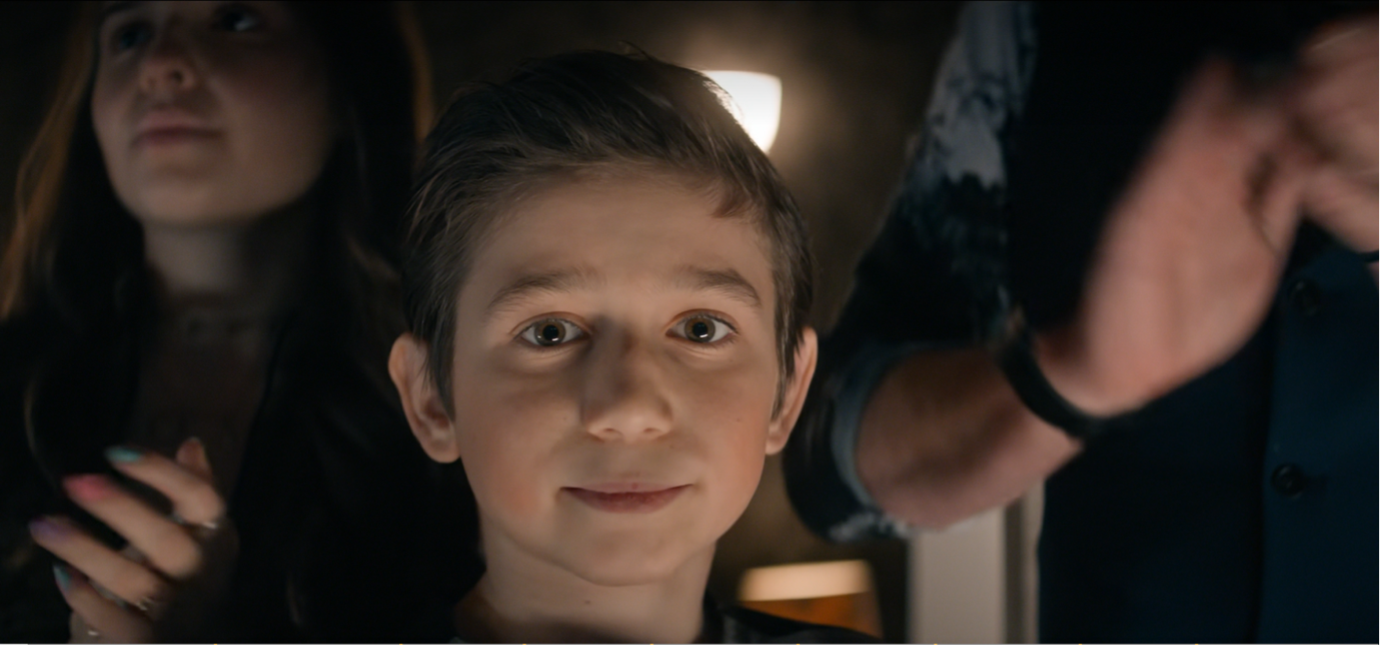
Set immediately against Macron’s national address which opens Stuck Together, Basile’s alternating point-of-view framing and direct address to the camera immediately resituate authority at the level of personal and lived experience. This framing occurs as part of a communal show of solidarity for the emergency services through clapping and the banging of pots and pans from the individual apartments overlooking the central courtyard. As Basile’s voiceover recounts to the spectator his parents’ separation, his father’s bullying tendencies, and his opinions of the other tenants in the apartment block—derogatory views largely inherited from his father—the film filters the national crisis through a child’s impressionable consciousness. The spectator is aligned with Basile’s perspective from the start. They are alongside him in the opening sequence as he claps for hospital workers while introducing neighbours that he too does not know himself, identifying them through functional labels—“le biologue d’analyses médicales” (the medical analysis biologist), “la patronne du bistrot” (the restaurant owner), “la fille [des flipocondriaques]” (the girl [of the hypochondriacs]). Mimicking his father, Basile restates the divide between the “propriétaire” (his father, the proprietor of the block of apartments) and the “locataires” (renters), which highlights how social boundaries are shaped and reiterated within the domestic setting.
Figure 3: Basile’s perspective being set up. Stuck Together, Dany Boon, 2021. Screenshot.
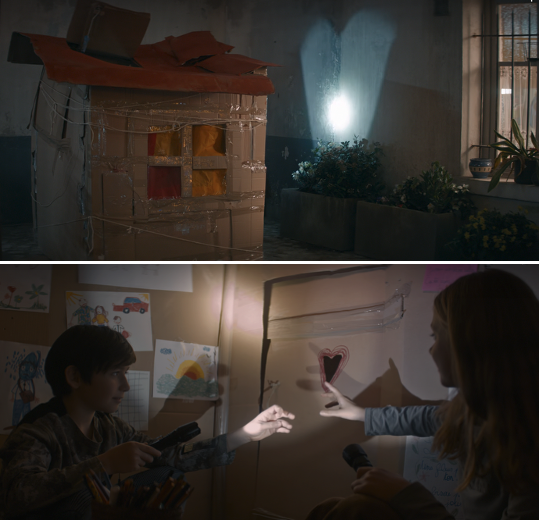
This perspective is, however, not entirely stable. There is a section in the sequence that is visually beyond what Basile can witness, when he introduces “la patronne du bistrot” who is seen beating her drum in the street outside the apartment block. The point-of-view shot also temporarily flips to that of Louna’s as she observes her anxious father, scientific illustrator Martin, have a panic attack when he envisions the physical impact of COVID-19. These initial scenes reveal the construction of the child’s eye view, but perhaps equally the pressures of rapid production under pandemic conditions given the shifts in point-of-view shot. Much of what follows throughout the film is framed from the chid perspective: the awkwardness of online schooling; the courtyard reimagined as a playground and communal stage; the dog (also named Basile) as an intermediary for naïve declarations of love between Louna and Basile; makeshift entrepreneurial schemes; and drawings, poems, and flowers as gestures of childhood emotion and intimacy. The cardboard Wendy house constructed within the courtyard—almost as a house within a house—makes literal an internal imaginative world. This world is extended through shadow-play sequences between Basile and Louna, which foreground the boundless capacity of fantasy and storytelling, and the resourceful use of available light and everyday objects.
The experience of confinement is also reshaped through the child figure as connecting node. Basile’s unfiltered disclosures—such as when he tells Mme. Louise about his father’s plans to take over her restaurant once she goes under due to the lockdown, or dies—point to social and generational fracture, but they also eliminate ambiguity and foster longer-term trust (as harsh as the initial declaration might be). The improvised production of pear-scented hand sanitiser between the two—triggered by a misinterpretation on Basile’s part over whether the “medicine” (Louise’s late husband’s pear liquor) should be swallowed or topically applied—collapses boundaries between playfulness and entrepreneurialism, and between individual and shared understandings across potential barriers such as age, for example. This reflects the negotiation of new meanings and exposes the limits of top-down management during times of crises, drawing attention to relationality and mutual dependence. Basile’s “Powerful Voice” t-shirt further highlights this redistribution of agency within this constrained microcosm, pointing to an unexpected authority granted to the child within the destabilised adult order. Basile and Louna’s own breach of confinement also enables a connection between the ostracised Dr. Leïla (Nawell Madani) and the rest of the inhabitants (the “community”) who now depend on her medical expertise to assess an injury sustained by Louna during the escapade. Louna’s reluctance to attend a hospital saturated with COVID-19 draws attention to the fragility of the institutional infrastructures and reorientates the locus of care from state-managed systems to community-based interdependent forms.
Figures 4 and 5: Courtyard cardboard Wendy house (above) and shadow-play (below).
Stuck Together, Dany Boon, 2021. Screenshots.
What emerges across the film through the child’s experience is a form of republican unity in which difference is subsumed within a shared crisis; yet this unity remains uncertain as hope for the future is dependent upon this difference being continually acknowledged and rearticulated as part of the lifespan cycle. The film concludes with a galvanised yet fragile sense of community, one which coalesces around birth and death—Diego (Jorge Calvo) is informed by Dr. Leïla that his wife, Paola (Clara Cirera), has died, and Agathe (Alison Wheeler) and Samuel (Tom Leeb) have just had their first baby. The final dedication, “Á celles et ceux qui ont souffert, Á l’humanité solidaire” (to those who have suffered, to humanity in solidarity), kickstarts a series of childlike animated drawings that emerges initially out of the historical background. The sequence therefore links the trajectories of Basile and Louna onto a futurity configured through the image of the child, which is further acknowledged in a thank you to the source of inspiration—“Sarah and Raphaël”, the children of Boon and Laurence Arné.
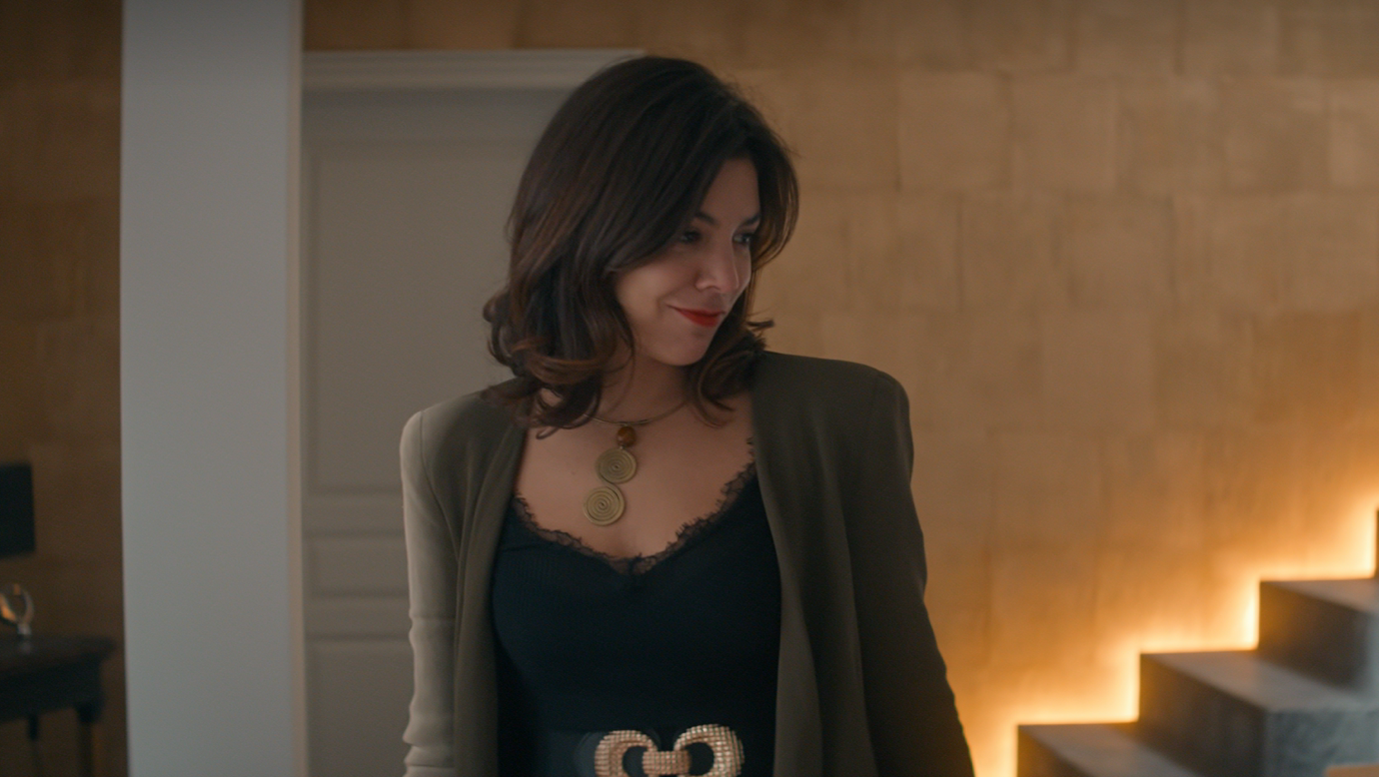
The cycle of life, and sense of community, however imagined, is epitomised in Isabelle’s (Myriam Bourguignon) restoration of the family unit at the end of the film. This idea is reinforced by the infinity symbol evoked in her belt and reflected in her necklace, which reiterates the figure of 8 of the film’s original title, 8 Rue de l’Humanité. The suggestion here is continuity and endurance in fundamental social bonds, which is evident in the coming together of all inhabitants within the courtyard of the apartment block (in the same place their disconnection was initially set out). The symbolic restoration of the family points towards a form of unity that resonates with, yet complicates, ideals of the French republic. The film thus foregrounds a tension between the abstract (i.e., the notion of infinity) and the concrete: while the pandemic is framed through the invisible virus and its management by the state, it is ultimately experienced through domestic space, interpersonal relationships, and practices of care and loss. These lived realities anchor the crisis in the present, while also exposing the limits of an abstract republican model that seeks unity without always fully accounting for difference. The universalist principle here has a non-civic troublesome counterpart in the UK in a liberal-individualist model that, when confronted by a collective crisis, revealed tensions between individual responsibility and the public infrastructures required to sustain everyday life.
Figure 6: Isabelle’s return. Stuck Together, Dany Boon, 2021. Screenshot.
Countering Neoliberal Rationality – Locked DownHowever defined, whether as a reactive set of market principles responsive to fiscal performance or as a programme reliant on the propagation of subjectivities motivated by the individual and commercial, the neoliberal ideal was threatened during the pandemic by the profound realisation of the vital role of public services in sustaining everyday life, of the vulnerability of the individual as an agent capable of navigating economic disruption, and of the collective endeavour as the most reliable way of managing upheaval (Crouch 34).
The main setting of Locked Down—61 Portland Street, London—is undoubtedly a marker of affluence and success. However, the inversion of “19” in “61” perhaps subtly references the disorientation and upheaval associated with COVID-19 at the domestic level. Within this microcosm, Linda and Paxton offer contrasting positions on the neoliberal front; she is a CEO working internationally, and he is an ex-prisoner struggling to find employment. Linda has been squaring up to her corporate image within the “emerging markets”, increasingly disliking what she sees in the mirror having just sacked her Events team on her boss’s orders. Paxton is only employable under highly precarious conditions, including working under the false name of “Edgar Allan Poe”. While this new identity may chime with his proclivities for writing and poetry during lockdown, it also feeds into the on-demand and flexible employment arrangements that only really benefit the organisation.
While the sheer scale of this townhouse facilitated compliance with COVID-19 filming restrictions, the setting complicates any straightforward association between space and freedom. The dialogue-driven structure propels the narrative conceptually beyond the immediate confines of the townhouse, yet it also paradoxically and simultaneously intensifies the emotional pressures of cohabitation—dynamics that are particularly evident in what is termed the “confession avalanche”, a rapid succession of disclosures that allow pent-up feelings and truths to come out.
During one such exchange, Paxton responds to Linda’s exasperation and general unhappiness with her role as CEO by saying, “you are unhappy in an outwardly ‘happy let’s pretend it’s all fine’ female way, and I am unhappy in an obviously thwarted,—unfulfilled, castrated male way”. Linda is struggling to self-regulate and to be in control of her actions, she has started smoking again and admits to adding two shots of vodka to her breakfast smoothy most days. Paxton struggles with a sense of impotence in being unable to contribute to the system in any productive way, revealing how he had a momentary relapse into a former drug habit when he licked the sap of opium poppies in the garden to alleviate his insomnia. Harking back to the 1970s “hippies” who grew them, Paxton jokes with Linda, “Our garden is full of heroin. You go beyond the washing line, it’s like the Helmand Province”.
The exchange condenses some of the limits of neoliberal individualism, highlighting how gendered, classed, and racialised identities shape the way in which each character experiences agency on a personal and professional level. The postfeminist and pervasive neoliberal expectation that women are freely in charge of their public and personal lives—and that this is something to which they should continually aspire—reiterates how neoliberalism lacks the neutral position it claims (Gill and Scharff 7). In a similar vein, Paxton’s precarious employment status reflects the variegated “subordinated masculinities” shaped by class and race within a competitive neoliberal economy (Cornwall 9). The superficial promises and commodified features of neoliberalism obscure deeper structural inequalities from which subjects have become increasingly distanced, but which remain relevant in terms of how they should organise themselves as autonomous individual agents.
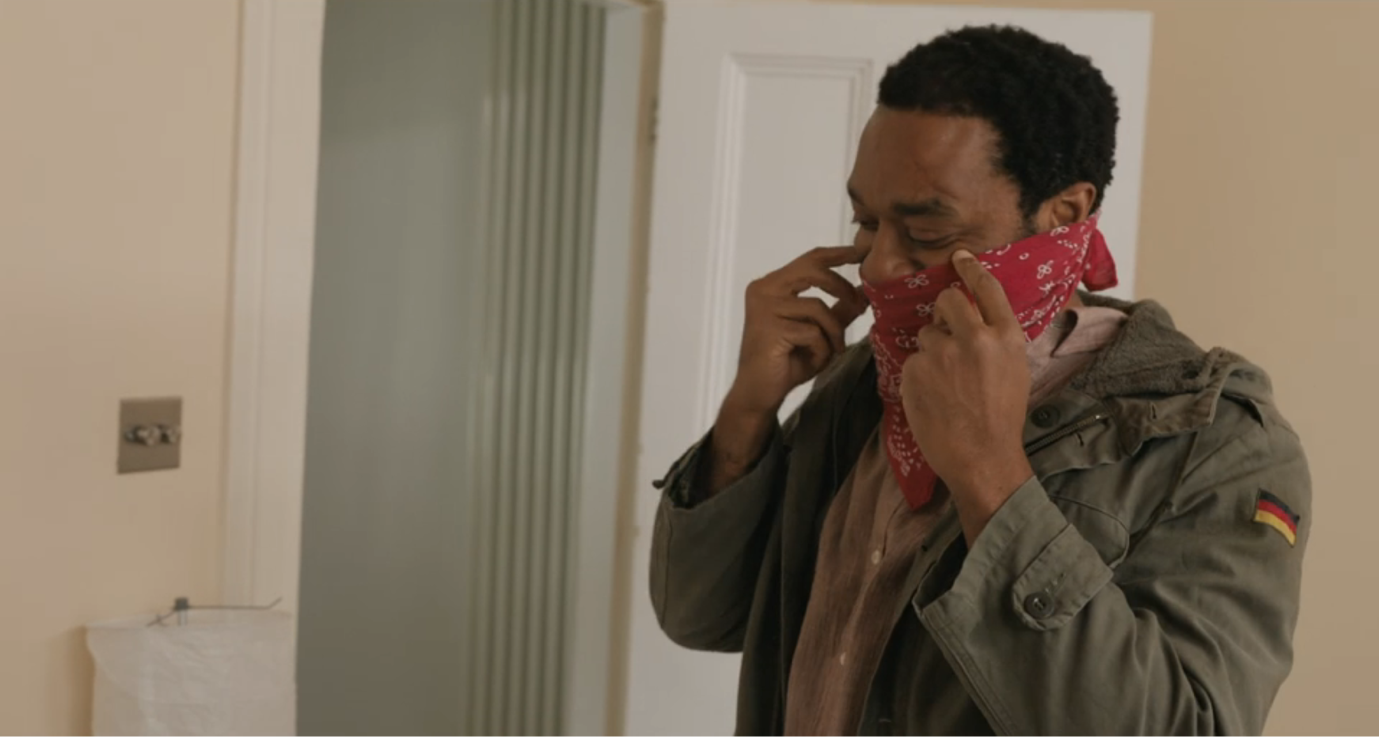
The confession avalanche is a critical turning point, triggering a sequence of events that challenge the inevitability of their deteriorating personal circumstances. Despite the antagonisms of the relationship, Linda and Paxton gradually reconnect through the sense of a long-lost freedom nostalgically reevoked in Paxton’s love of biking and the wearing of an old bandana as a substitute facemask when going out for provisions. They first met in Sturgis, South Dakota—a mecca for bikers across the world—which allows Linda to affectionately recall her once rebellious “desperado”. As a biker, he takes on a countercultural “bad boy” image here —which, in the case of Locked Down and drawing on the work of Leerom Medovoi and Donald E. Pease in Rebels, can be evaluated against what he might do for the wider public good (40).
Figure 7: Paxton rediscovers his bandana. Locked Down, Doug Liman, 2021. Screenshot.
Paxton’s motorbike is a recurring motif throughout the narrative, initially associated with the possibility of his own suicide before later rekindling his inner fire and then facilitating the heist getaway. However, it is the immediacy and ability to make a self-determined choice in these sections of the narrative that proves to be the most significant challenge to neoliberal rationality. Although the Harrods heist depends upon careful organisation and planning, and Linda’s insider information, its success hinges ultimately on an ability to decide and to act in the moment (i.e., to be in control of making a choice). This logic of immediacy is epitomised in the substitution of the real Harris diamond with a replica, a swap that foregrounds contingency and situated agency over determinism. This type of improvised agency, often in very sensitive situations, sits uneasily alongside neoliberal logics of control, calculation, and strategy, particularly when it results from (and/or exposes) a growing awareness of the structural inequalities shaping individual lives. As Linda herself observes, the COVID-19 pandemic has created a broad space for self-reflection.
Figure 8: Substituting the real Harris diamond for the fake one, deciding in the moment.
Locked Down, Doug Liman, 2021. Screenshot.
Regulation of the body, both on an individual and collective level, is also resisted in Paxton’s turn to poetry during lockdown. Early on, in a state of despondency, he admits that he can no longer distinguish between “what is [his] body and what is the furniture”, a sentiment that articulates the spatiotemporal and psychic disorientation of confinement. His public recitation of D.H. Lawrence’s Stand Up! reflects an effort to emerge from these feelings.
In entertaining his “fellow inmates” of the “Portland Street Prison”, as he calls it, he recites:
Stand up, but not for Jesus!
It’s a little late for that.
Stand up for justice and a jolly life.
I’ll hold your hat.Stand up, stand up for justice,
ye swindled little blokes!
Stand up and do some punching,
give ‘em a few hard pokes.Stand up for a new arrangement
for a chance of life all round
for freedom, and the fun of living
bust in, and hold the ground![4]
The poem reframes justice in personal and social terms, challenging hierarchical structures of authority, and, within the broader context of Lawrence’s poetry, insisting upon “the ‘present’ as the only point of origin (of thought, of the self) to which we have unmediated access” (Becket 80). In the context of the COVID-19 pandemic, an experience shaped by state regulation and control, and heavily mediated through digital technologies, this emphasis on the “unmediated” present reclaims an immediacy that counters the sense of estrangement from self and others produced not just by the pandemic but also by the broader neoliberal agenda.
The film’s broader reorientation is towards the limits and inequalities of neoliberal market principles, a critique epitomised through the theft of the Harris diamond and the “philanthropic” act of donating one million pounds of its proceeds to the NHS (while retaining the remaining two million pounds for Linda and Paxton). The sale is made untraceable through Archie Bruce, the very same criminal whose life Paxton once saved in an impulsive act of violence by “[beating] a man senseless in a bikers’ roadhouse in Watford”—an action which would ultimately lead to his own imprisonment. The ethical ambiguities of such “in-the-moment” actions expose however a tension between neoliberal rhetoric and the unequal conditions under which agency can be exercised, revealing the limits of a system that claims to be fair and universally accessible.
Paxton’s recitation in the final sequence of Robert Graves’s Counting The Beats, framed so that “Not there but here” refers specifically to Portland Street, continues Lawrence’s justice by forging a more definitive connection between himself and Linda, their neighbours, and the spectator who circles him through the camera’s mobile gaze.
Grave’s experiences of the devastation of love and war come through in the poem (Mason; Gibson), which meditates on intimacy and the ephemerality of time—”The bleeding to death of time in slow heart beats, Wakeful they lie”—in a way that captures the suspended and distended temporality of lockdown.[5] The performance takes place on Paxton’s birthday, which Linda has completely forgotten. His clear indifference to this, however, further reinforces the film’s reorientation to immediacy and lived experience over commemorative or sequential indicators of time. The encounter between the pair reinforces an important distinction between chronological and lived temporalities: the calendared dates move forward, yet there is a stalling in the individual experience of time.
The corporeality and intimacy of the poem unite Linda and Paxton in a shared sense of inevitability, an intensified anguish perhaps relating to the end of their relationship or to the ongoing threat of the virus as a new lockdown is set for two more weeks (extending their petty antagonisms, as Paxton is still unable to leave). In shifting the intimacy of the poem from the house to the street, however, the sentiment becomes collective—particularly as the camera shot and movement reduce the spectator’s distance from the representation. There is a shared consciousness in the reflexive structuring in this section of the film that acts as a quiet resistance reflective of the poem.
Epitomised in the contrasting positions between Paxton and Linda, neoliberal rationality and governance render everyone precarious, either through the direct experience of inequality or through the persistent threat of vulnerability despite various securities being in place within the system. However, the collective gathering staged through the street performance—considered as a kind of reconfigured assembly in Butlerian terms (given lockdown restrictions)—momentarily captures a shared vulnerability and exposes the contradictions inherent in the neoliberal project (Butler 9, 14). The scene thus acknowledges crisis while reimagining an alternative collective formation so far foreclosed by logics centring on the individual.
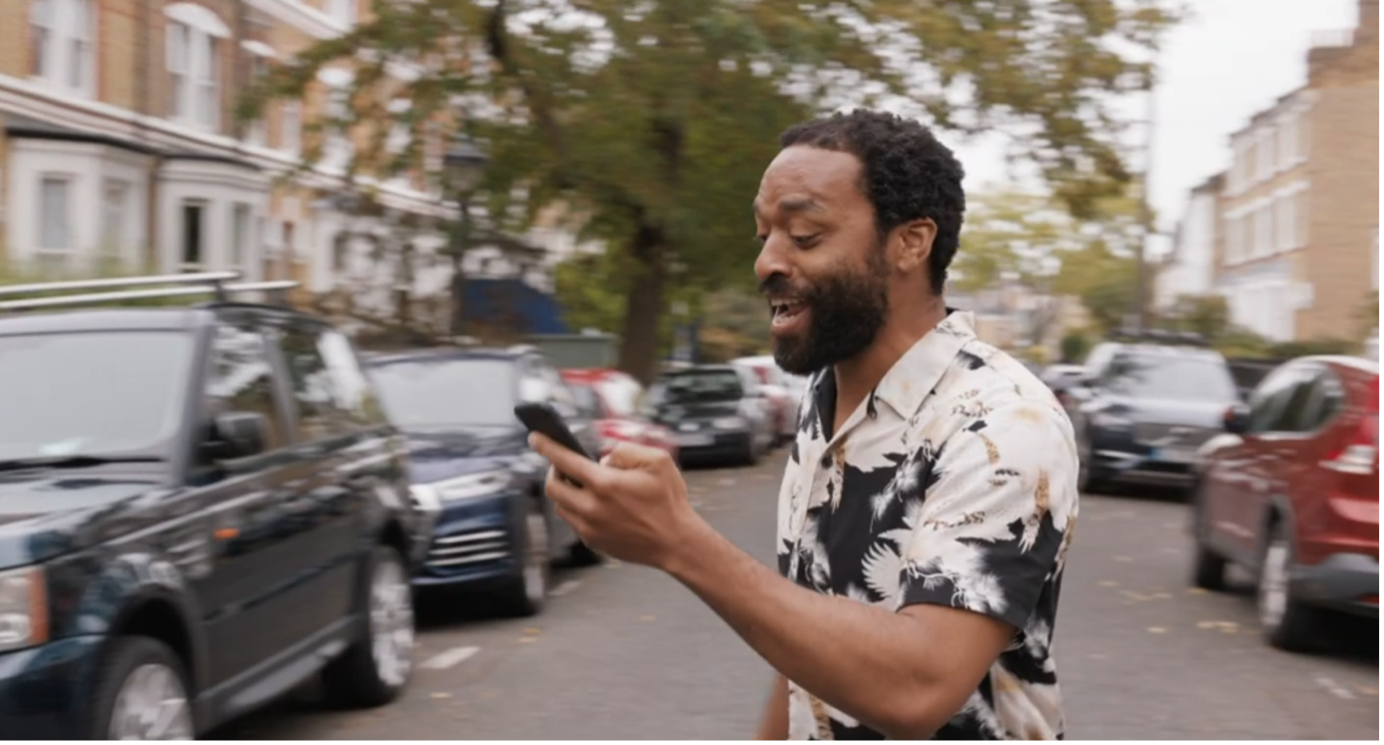
Figure 9: Paxton reciting Robert Graves’s Counting The Beats.
Locked Down, Doug Liman, 2021. Screenshot.
Conclusion
The recourse to comedy in these three films reflects a specific representational attachment within a much wider repertoire of mediated responses to the pandemic and destabilisation of attachments to the good life. The often-negative reception of the films formed part of this cultural negotiation, revealing a dissatisfaction with how the crisis should be represented without resolving quite what an adequate representation should look like. Although fictional, the films hold a documentary impulse in attempting to make sense of an unfolding crisis while still living out that crisis. In this way, comedy is seen to complement the available resources through which lived experience can be narrativised under conditions of uncertainty.
As attachments to everyday social life came under pressure, and confidence in institutional authority became increasingly fragile, comedy offered a means of negotiating uncertainty rather than necessarily seeking to overcome it. With the potential to be simultaneously reassuring and disruptive, and affective and reflexive, the deployment of comedy within these films helps narrativise an impasse in which new orientations are tentatively played out but which remain unresolved.Berlant’s concept of the impasse assumes different forms depending on the situation from which it emerges, yet it is consistently characterised by sudden social disruption and improvisation, and a persistent present in which established guarantees no longer hold (199–200). Berlant also articulates the impasse as borderless in its capacity to accommodate a number of genres at the same time (199–200). The urge to classify these films according to discrete genres can therefore be understood as an attempt to restore orientation within the impasse, while their formal reflexivity and hybridity resist such stabilisation.
It is precisely through a consideration of these provisional representational adjustments however that the political potential of the films is realised. Deleuze and Guattari’s concept of cramped space is productive, then, in broadly framing these three films as pandemic cultural documents occupying a charged and unresolved position somewhere between fiction and documentary, entertainment and critique, and individual experience and collective crisis.
At the beginning of this article, I suggested an analogy between the construction of the films and the public health responses to the pandemic. This relationship is through shared cultural attachments. Whatever the individual attachments that organise the lives of the characters—for example, Mariella’s bella figura, Giovanni’s performance of masculinity, Basile’s intergenerational obligations, and Linda and Paxton’s pursuit of professional and romantic fulfilment— these “[gestures]” reveal broader cultural attachments that exceed the individual (Berlant 199). The domestic sphere becomes then the site through which national imaginaries are negotiated, with the respective public health responses (which were experienced intensely) shaping the conditions under which these culturally specific attachments are expressed and reviewed simultaneously. The distinct sociopolitical traditions of regionalised identities and governance in Italy, republican ideals of the collective in France, and liberal-individualist notions of responsibility in the UK are seen clearly to frame how attachments to community and responsibility are imagined. The threshold of risk between the inside and the outside thus operates concurrently as a historical and representational condition, where comedy, fiction, documentary, and lived experience converge to create the productive limbo of Berlant’s impasse.
Notes
[1] Marco Serafini’s film Il cinema non si ferma (2020) was filmed entirely on smart phones, with all funds generated going to the Dipartmento della Protezione Civile (Department of Civil Protection) which was largely responsible for supporting the pandemic response. The team of actors viewed the production as a form of resistance, asserting the right to continue working and to participate in the response. It was produced across March and April 2020 and released in July 2020 (“Il cinema”; Gallo). Romuald Boulanger’s film Connectés (2020) was conceived during the first lockdown and took only eight days to shoot, being released by coincidence during the second lockdown in November 2020 (Lachasse). The film is structured around a videoconference in which a group of friends meet up one Saturday evening for an online aperitif during which one of them is held captive and the others are forced to confront their impotence from a distance through the mediated space of the screen. Boulanger explained that telling stories that resonated on a deeply personal level remained as important as ever during the COVID-19 period (“La pandémie”; Lachasse). Simon Evans’s Staged (2020), starring David Tennant and Michael Sheen, was motivated by a need to sustain creativity in the face of opposition and to be part of a broader perspective on the pandemic. The series centres on the rehearsing of Pirandello’s Six Characters in Search of an Author in anticipation of a public once again eager and able to attend live performances when restrictions eased. The first episode went out in June 2020 (Staged).
[2] During the COVID-19 pandemic, this expansion was most notable in the now recognisable use of “drone imagery, graphs, curves, and charts, and the online videos produced and circulated by ordinary citizens” (Kim, “Data Visualizations”). Other examples include GoPro, virtual reality, documentary installations (in museums, for example), and interactive documentaries (individual engagement at a digital interface) (Kim, Documentary’s Expanded Fields).
[3] Simon Evans’s Staged demonstrates how parody could still function during the pandemic when anchored to a fixed text, in this case Luigi Pirandello’s Six Characters in Search of an Author.
[4] For the full version, see: https://kalliope.org/en/text/lawrence2001061204.
[5] See Mason’s book review in end-list for copy of the full poem.
References
1. Augé, Marc. Non-Places: Introduction to an Anthropology of Supermodernity. Translated by John Howe, Verso, 1995.
2. Baarck, Julia, Béatrice d’Hombres, and Guido Tintori. “Loneliness in Europe before and during the COVID-19 Pandemic.” Health Policy (Amsterdam), vol. 126, no. 11, Nov. 2022, pp. 1124–29, https://doi.org/10.1016/j.healthpol.2022.09.002.
3. Baudin, Julia. “8 Rue de l’Humanité: une comédie Netflix estampillée Dany Boon.” Ouest-France, 20 Oct. 2021, https://www.ouest-france.fr/medias/television/8-rue-de-l-humanite-une-comedie-netflix-estampillee-dany-boon-309b8568-30e1-11ec-a718-a624d0d4b41d.
4. Becket, Fiona. D. H. Lawrence. Taylor & Francis, 2002.
5. Berlant, Lauren Gail. Cruel Optimism. Duke UP, 2011.
6. Bibliothèque Nationale de France. COVID-19 and the Lockdown of March 2020 in the Web Archives. Web archive collection, BnF digital legal deposit, 1 Feb.–31 July 2020, https://www.bnf.fr/en/covid-19-and-lockdown-march-2020-web-archives.
7. Bodini, Aimone, et al. “Envisioning the Future of Virtual Production in Filmmaking: A Remote Co-Design Study.” Multimedia Tools and Applications [New York], vol. 83, no. 7, February 2024, pp. 19015–39, https://doi.org/10.1007/s11042-023-16308-7.
8. Boitani, Giacomo. “Revisiting the Past as a Means of Validation: Bridging the Myth of the Resistance and the Satire of the Economic Miracle in Two Comedies ‘Italian Style’.” Alphaville: Journal of Film and Screen Media, no. 2, Winter 2011, https://www.alphavillejournal.com/Issue%202/HTML/ArticleBoitani.html.
9. Boon, Dany, director. Stuck Together (8 Rue de l’Humanité). Pathé,2021.
10. Boon, Dany, director. Welcome to the Sticks (Bienvenue chez les Ch’tis). Pathé, 2008.
11. Borgschulte, Mark, and Yuci Chen. “Youth Disconnection During the COVID-19 Pandemic.” Labour Economics, Oct. 2022, https://doi.org/10.1016/j.labeco.2022.102241.
12. Bosa, Iris et al. “Response to COVID-19: Was Italy (Un)Prepared?” Health Economics, Policy and Law, vol. 17, no. 1, 2022, pp. 1–13, https://doi.org/10.1017/S1744133121000141.
13. Boulanger, Romuald, director. Connectés. R-Lines Productions, 2020.14. Brest, Martin, director. Scent of a Woman. Universal Pictures, 1992.
15. Bruzzi, Stella. New Documentary: A Critical Introduction. 2nd ed., Routledge, 2006.
16. Butler, Judith P. Notes toward a Performative Theory of Assembly. Harvard UP, 2015.
17. Capano, Giliberto. “Policy Design and State Capacity in the COVID-19 Emergency in Italy: If You Are Not Prepared for the (Un)expected, You Can Be Only What You Already Are.” Policy and Society, vol. 39, no. 3, Sept. 2020, pp. 326–44. https://doi.org/10.1080/14494035.2020.1783790.
18. Cassan, Guilhem, and Marc Sangnier. “The Impact of 2020 French Municipal Elections on the Spread of COVID-19.” Journal of Population Economics, vol. 35, no. 3, July 2022, pp.963–88, https://doi.org/10.1007/s00148-022-00887-0.
19. “Il Cinema non si ferma, su Rai Cinema Channel la commedia di Marco Serafini girata durante il primo lockdown.” Cinecorriere, 17 Mar. 2021, https://www.cinecorriere.it/2021/03/il-cinema-non-si-ferma-su-rai-cinema-channel-la-commedia-di-marco-serafini-girata-durante-il-primo-lockdown.
20. Cornwall, Andrea. “Introduction: Masculinities Under Neoliberalism.” Masculinities Under Neoliberalism, edited by Andrea Cornwall, Frank G. Karioris, and Nancy Lindisfarne, Bloomsbury Collections, 2016, pp. 1–28.
21. “Coronavirus: un rassemblement de Schtroumpfs fait polémique en France.” Le Soir, 10 Mar. 2020, www.lesoir.be/286002/article/2020-03-10/coronavirus-un-rassemblement-de-schtroumpfs-fait-polemique-en-france.
22. Corteilles, Claire. “8 Rue de l’Humanité: film Netflix avec Dany Boon sur le confinement.” Nouveautés-Télé, 20 Oct. 2021, https://www.nouveautes-tele.com/147596-8-rue-de-lhumanite-film-netflix-avec-dany-boon-sur-le-confinement.html.
23. Crawford, Paul, and Jamie Orion Crawford. Cabin Fever: Surviving Lockdown in the Coronavirus Pandemic. Emerald Publishing Limited, 2021.
24. Cremona, Patrick. “Doug Liman Explains Why Locked Down Is More Than Just a Pandemic Movie.” Radio Times, 10 Mar. 2021, https://www.radiotimes.com/movies/doug-liman-locked-down-pandemic-film-exclusive.
25. Crewe, James. “‘Last Night, Locked In.” SCREENWORKS: The Journal of Practice Research in Film and Screen Media, vol. 12, no. 1, 2022, https://doi.org/10.37186/swrks/12.1/4.
26. Crouch, Colin. “Reflections on the COVID Moment and Life beyond Neoliberalism.” Transfer, vol. 28, no. 1, Feb. 2022, pp. 31–45, https://doi.org/10.1177/10242589221078125.
27. Davies, William, et al. Unprecedented? How Covid-19 Revealed the Politics of Our Economy. Goldsmiths Press, 2022.
28. Degroult, Nathalie. “Bienvenue chez les Ch’tis: approche pédagogique d’un film de ch’nord.” The French Review, vol. 85, no. 1, Oct. 2011, pp. 76–90, https://doi.org/10.1353/tfr.2011.0074.29. Deleuze, Gilles, and Félix Guattari. Kafka: Toward a Minor Literature. Translated by Dana Polan, U of Minnesota P, 1986.
30. De Waard, Andrew, and R. Colin Tait. The Cinema of Steven Soderbergh: Indie Sex, Corporate Lies, and Digital Videotape. Wallflower, 2013, https://doi.org/10.7312/dewa16550.
31. Eitzen, Dirk. “When Is a Documentary? Documentary as a Mode of Reception.” Cinema Journal, vol. 35, no. 1, Oct. 1995, pp. 81–102, https://doi.org/10.2307/1225809.
32. Evans, Simon, director. Staged. BBC, 2020.
33. Finos, Arianna. “Vanzina dopo le polemiche su Lockdown all’italiana, ‘Sul diritto alla commedia mi aspettavo la solidarietà dei colleghi’.” La Republblica, 25 Sept. 2020, https://www.repubblica.it/spettacoli/cinema/2020/09/25/news/vanzina_sul_diritto_alla_commedia_mi_aspettavo_
la_solidarieta_dei_colleghi_268470450/?callback=in&code=
NDC2OGQXYMQTN2E2NI0ZZMY0LWJMNWUTNGFKNTY1Y2VINTJJ&state=0c47eb6c1be4449eb374172968e789d0.34. Fleming, Mike Jr. “Doug Liman: Pulling Off Pandemic Heist Film Locked Down Steeled His Courage To Shoot In Outer Space With Tom Cruise.” Deadline, 14 Jan. 2021, https://deadline.com/2021/01/doug-liman-locked-down-tom-cruise-spacex-movie-anne-hathaway-chiwetel-ejiofot-1234674023/.
35. Foucault, Michel. Discipline and Punish: The Birth of the Prison. Translated by Alan Sheridan, Penguin Books, 2021.
36. Gallo, Giuseppe. “IL CINEMA NON SI FERMA. Intervista al cast tecnico e artistico.” YouTube, 21 March 2021, https://www.youtube.com/watch?v=FUzFCucfEMI.
37. Gibson, Alisdair G. G. “Introduction.” Robert Graves and the Classical Tradition, edited by Alisdair G. G. Gibson, Oxford UP, 2015, pp. 1–20, https://doi.org/10.1093/acprof:oso/9780198738053.003.0001.
38. Gill, Rosalind, and Christina Scharff. “Introduction.” New Femininities: Postfeminism, Neoliberalism and Subjectivity, edited by Rosalind Gill and Christina Scharff, Palgrave Macmillan UK, 2011, pp. 1–17, https://doi.org/10.1057/9780230294523.
39. Giuffrida, Angela. “Italian Critics Aghast at ‘Demeaning’ Comedy that Makes Light of Pandemic.” The Guardian, 16 Oct. 2020, https://www.theguardian.com/world/2020/oct/16/italian-critics-aghast-at-lockdown-allitaliana-comedy-film-coronavirus-pandemic.
40. Gleiberman, Owen. “Locked Down Review: Anne Hathaway and Chiwetel Ejiofor Excel as a Couple in Lockdown in Doug Liman’s Up-to-the-Minute Pandemic Drama.” Variety, 13 Jan. 2021, https://variety.com/2021/film/reviews/locked-down-review-chiwetel-ejiofor-anne-hathaway-1234884187.
41. Hayes, Kevin J. Edgar Allan Poe. Reaktion Books, Limited, 2009.
41. Hennefeld, Maggie. “The Problem of Film Comedy in the Twenty-First Century.” New Review of Film and Television Studies, vol. 20, no. 1, Jan. 2022, pp. 101–18, https://doi.org/10.1080/17400309.2021.1968711.
43. Holaday, Louisa W., et al. “Loneliness, Sadness, and Feelings of Social Disconnection in Older Adults During the COVID-19 Pandemic.” Journal of American Geriatrics Society, vol. 70, no. 2, 20 Nov. 2021, https://doi.org/10.1111/jgs.17599.
44. Horton, Andrew, and Joanna E. Rapf. A Companion to Film Comedy. Wiley, 2012, https://doi.org/10.1002/9781118327821.
45. Iacobucci, Gareth. “Covid-19: England’s Health Declined in 2020, But Not Across All Areas.” BMJ, Nov. 2022, p. o2710, https://doi.org/10.1136/bmj.o2710.
46. Ietter, Salomé. “Back to Class? The Populism of the ‘Gilets jaunes.’” Journal of Political Ideologies, vol. 31, no. 2, Jan. 2025, pp. 1–20, https://doi.org/10.1080/13569317.2025.2449868.
47. Indolfi, Ciro, and Carmen Spaccarotella. “The Outbreak of COVID-19 in Italy: Fighting the Pandemic.” JACC: Case Reports. vol. 2, no. 9, July 2020, pp. 1414–18, https://doi.org/10.1016/j.jaccas.2020.03.012.
48. Jabr, Ferris. “How Realistic Is Contagion? The Movie Doesn’t Skimp on Science.” New Scientist, 6 Apr. 2020, https://www.newscientist.com/article/2239913-how-realistic-is-contagion-the-movie-doesnt-skimp-on-science.
49. Jørgensen, Frederik, et al. “Pandemic Fatigue Fueled Political Discontent during the COVID-19 Pandemic.” Proceedings of the National Academy of Sciences, vol. 119, no. 48, Nov. 2022, e2201266119, https://doi.org/10.1073/pnas.2201266119.
50. Journals of a Pandemic: A Project Recording Life in COVID-19. Mar. 2020–May 2021, SA/PAN. Wellcome Collection, 2021, https://wellcomecollection.org/works/nr8yyr5v. Accessed 4 July 2026.
51. Judor, Éric, director. Problemos. Albertine Productions / StudioCanal, 2017.
52. Kelley, Sonaiya. “How HBO Max’s Heist Dramedy Locked Down Was Conceived and Shot During the Pandemic.” Los Angeles Times, 19 Jan. 2021, https://www.latimes.com/entertainment-arts/movies/story/2021-01-19/locked-down-hbomax-doug-liman.
53. Kennedy, Jonathan. Pathogenesis: How Germs Made History. Penguin UK, 2023.
54. Kim, Jihoon. “Data Visualizations, Vlogs, Drone Imagery: Expanded Documentary Forms in the COVID-19 Emergency”, Film Criticism, vol. 45, no. 1, 2021, https://doi.org/10.3998/fc.1060.
55. Kim, Jihoon. Documentary’s Expanded Fields: New Media and the Twenty-First-Century Documentary. Oxford UP, 2022.
Lachasse, Jérôme. “Dans les coulisses de Connectés, le premier film français sur le confinement.” BFMTV, 12 Nov. 2020, https://www.bfmtv.com/culture/cinema-series/dans-les-coulisses-de-connectes-le-premier-film-francais-sur-le-confinement_AV-202011120034.html.56. Lee, Benjamin. “Locked Down Review – Anne Hathaway and Chiwetel Ejiofor in Pandemic Stinker.” The Guardian, 12 Mar. 2021, https://www.theguardian.com/film/2021/jan/13/locked-down-review-anne-hathaway-and-chiwetel-ejiofor-pandemic-stinker.
57. Liman, Doug, director. Locked Down. Warner Bros., 2021.
58. Lussier, Marc-André. “8 Rue de l’Humanité: La réponse de Dany Boon au désespoir.” La Presse, 20 Oct. 2021, https://www.lapresse.ca/cinema/entrevues/2021-10-20/8-rue-de-l-humanite/la-reponse-de-dany-boon-au-desespoir.php.
59. Manzione, Claudia. “Illness and War: Rereading Sontag’s Illness as Metaphor in the Post-Pandemic Era.” Balthazar, vol. 8, no. 2, pp. 82–96, 2025, https://doi.org/10.54103/balthazar/28615.
60. Marshall, Michael. “Horror Movie Fans Are Better at Coping with the Pandemic.” New Scientist, vol. 247, no. 3290, 11 July 2020, p. 8a, https://doi.org/10.1016/S0262-4079(20)31189-1.
61. Marzo, Jorge Luis. “The Curve: Space, Time and Disaster.” PhD_KORE Review, no. 17, July 2022, pp. 11–26.
62. Mason, David. “The One Story of Robert Graves.” The Hudson Review, vol. 72, no. 1, Spring 2019, pp. 132–41, https://hudsonreview.com/2019/05/the-one-story-of-robert-graves.
63. McNeill, William Hardy. Plagues and Peoples. Anchor Books, 1998.
64. Medovoi, Leerom, and Donald E. Pease. Rebels: Youth and the Cold War Origins of Identity. Duke UP, 2005.
65. Menetti, Elisabetta. “Testimonianza. Diario collettivo ai tempi della pandemia: Griseldaonline, 3–15 aprile 2020.” Laboratoire italien, no. 27, 2021, https://doi.org/10.4000/laboratoireitalien.7368.
66. Mills, Brett. “Comedy Verite: Contemporary Sitcom Form.” Screen, vol. 45, no. 1, Spring 2004, pp. 63–78, https://doi.org/10.1093/screen/45.1.63.
67. Moralli, Melissa, and Giulia Allegrini. “Crises Redefined: Towards New Spaces for Social Innovation in Inner Areas?” European Societies, vol. 23, no.1, pp. 1–13, https://doi.org/10.1080/14616696.2020.1841263.
68. Mulubale, Sanny, Poul Rohleder, and Corinne Squire. “LOLS@stigma: Comedy as Activism in the Changing Times of the HIV Epidemic.” Critical Public Health, vol. 31, no. 3, 2021, pp. 255–67, https://doi.org/10.1080/09581596.2020.1838445.
69. “The Mysteries of Enrico Vanzina.” Excellence Magazine, 9 Apr. 2018, https://www.excellencemagazine.luxury/the-mysteries-of-enrico-vanzina/.
70. Nash, Kate. “Covid-19 Conspiracy Documentary: Claiming the Real in a Context of Uncertainty.” It’s The Media Stupid! Essays in Honour of Brian Winston, edited by Richard Lance Keeble, Abramis Academic Publishing, 2022, pp. 52–64.
71. Nichols, Bill. Introduction to Documentary. 2nd ed., Indiana UP, 2010.
72. Niola, Gabriele. “Abbiamo chiesto ad Enrico Vanzina perché ha fatto Lockdown all’italiana.” BadTaste Film, 13 Oct. 2020, https://www.badtaste.it/interviste/abbiamo-chiesto-ad-enrico-vanzina-perche-ha-fatto-lockdown-all-italiana.
73. Or, Zeynep et al. “France’s Response to the Covid-19 Pandemic: Between a Rock and a Hard Place.” Health Economics, Policy and Law, vol. 17, no. 1, Jan. 2022, pp. 14–26, https://doi.org/10.1017/S1744133121000165.
74. “La pandémie de coronavirus s’installe progressivement dans les fictions télé.” RTS, 6 Sept. 2021, https://www.rts.ch/info/culture/series/11749291-la-pandemie-de-coronavirus-sinstalle-progressivement-dans-les-fictions-tele.html.
75. Pabel, Anja, and Maja Turnšek. “Travel-Related Humour and COVID-19: Insights from Memes.” European Journal of Humour Research, vol. 10, no. 3, Oct. 2022, pp. 211–16. https://doi.org/10.7592/EJHR.2022.10.3.659.
76. “Partout en France, une Fête de la musique ‘corona-compatible’ inédite à l’heure de la distanciation sociale.” Le Monde, 21 June 2020, www.lemonde.fr/culture/article/2020/06/21/partout-en-france-une-fete-de-la-musique-corona-compatible-inedite-a-l-heure-de-la-distanciation-sociale_6043656_3246.html.
77. Pulcini, Elisabetta. “Locked Down – A Failed Attempt to Capture the Zeitgeist Review.” The Indiependent, 23 Apr. 2021, https://www.indiependent.co.uk/locked-down-a-failed-attempt-to-capture-the-zeitgeist-review.
78. Riaux, Simon. “8 Rue de l’Humanité: critique du confinement de Dany Boon sur Netflix.” Écran Large, 3 July 2023, www.ecranlarge.com/films/critique/1401018-8-rue-de-lhumanite-critique-dun-dany-boon-vomitif-sur-netflix.
79. Robertson, Emma. “Doug Liman: ‘I’m Not Interested in Easy’.” The Talks, n.d., https://the-talks.com/interview/doug-liman.
80. Schatz, Thomas. “Preface.” The Cinema of Steven Soderbergh: Indie Sex, Corporate Lies, and Digital Videotape,editedby Andrew DeWaard and R. Colin Tait, Wallflower, 2013, pp. 1–10, https://doi.org/10.7312/dewa16550.
81. Scola, Ettore, director. La terrazza. Dean Film / Marceau-Cocinor, 1980.
82. Scrivner, Coltan, et al. “Pandemic Practice: Horror Fans and Morbidly Curious Individuals Are More Psychologically Resilient During the COVID-19 Pandemic.” Personality and Individual Differences, vol. 168, no. 110397, Jan. 2021, https://doi.org/10.1016/j.paid.2020.110397.
83. Sequeira, Gayle. “10 Great Edgar Allan Poe Adaptations.” British Film Institute, 12 Oct. 2023, https://www.bfi.org.uk/lists/10-great-edgar-allan-poe-adaptations.
84. Serafini, Marco, director. Il cinema non si ferma. Deltadue Media / Co-Production, 2020.
85. Soderbergh, Steven, director. Contagion. Warner Bros. Pictures, 2011.
86. Soncini, Guia. “Lockdown all’italiana: L’invidia dei twittaroli che sognavano di fare un film sulla quarantena, mentre Vanzina lo ha già diretto.” Linkiesta, 18 Sept. 2020, https://www.linkiesta.it/2020/09/lockdown-italiana-cinema-vanzina-greggio.
87. Spettacolomania. “Lockdown all’italiana: Enrico Vanzina, Ezio Greggio, Martina Stella, Paola Minaccioni, Ricky Memphis.” YouTube, 12 Oct. 2020, https://www.youtube.com/watch?v=aOXvyYOAXiw.
88. Staged. Created by Simon Evans and Phin Glynn, performances by David Tennant, Michael Sheen, Georgia Tennant, Anna Lundberg, Simon Evans, and Lucy Eaton, BBC One, 2020–2022. BBC iPlayer, https://www.bbc.co.uk/iplayer/episodes/p08dnl67/staged. Accessed 5 July 2026.
89. Taylor, Peter Shawn. “Recession Tonic: Scarlett O’Hara.” Maclean’s, vol. 122, no. 7, 2 Mar. 2009, p. 49.
90. Tran-Gervat, Yen-Mai. “Pastiche.” Encyclopedia of Humor Studies, edited by Salvatore Attardo, vol. 2, SAGE Publications, 2014, pp. 554–57.
91. UK Parliament. Coronavirus. Hansard, House of Commons, vol. 673, 9 Mar. 2020, https://hansard.parliament.uk/commons/2020-03-09/debates/5CEB539A-09F2-4268-9D6C-D60D0D170634/Coronavirus.
92. Vampa, Davide. “COVID-19 and Territorial Policy Dynamics in Western Europe: Comparing France, Spain, Italy, Germany, and the United Kingdom.” Publius, vol. 51, no. 4, Sept. 2021, pp. 601–26, https://doi.org/10.1093/publius/pjab017.
93. Vandenberghe, Ameline. “Alternative Narratives of the Covid-19 Pandemic: A Symptom of Distrust and Divide.” The COVID-19 Pandemic: Ethical Challenges and Considerations,edited by Eleftheria Egel and Cheryl Patton. Ethics International Press Limited, 2022, pp. 1–23.
94. Vanzina, Carlo, director. Sapore di mare. International Dean Film, 1983.
95. Vanzina, Enrico, director. Lockdown all’Italiana. Medusa Film, 2020.
96. Walters, William, and Barbra Lűthi. “The Politics of Cramped Space: Dilemmas of Action, Containment and Mobility.” International Journal of Politics, Culture and Society, vol. 29, 2016, pp.359–66, https://doi.org/10.1007/s10767-016-9237-3.
97. Wegwarth, Odette, et al. “The Impact of Nontransparent Health Communication during the COVID-19 Pandemic on Vaccine-Hesitant People’s Perception of Vaccines.” Frontiers in Public Health, vol. 11, Jan. 2024, p. 1256829, https://doi.org/10.3389/fpubh.2023.1256829.98. Willen, Sarah S., et al. “The Pandemic Journaling Project: A New Dataset of First-Person Accounts of the COVID-19 pandemic.” PLOS One, vol. 20, no. 9, 2025, p. e0318397, https://doi.org/10.1371/journal.pone.0318397.
99. Williams, Simon N., et al. “Effectiveness of Communications in Enhancing Adherence to Public Health Behavioural Interventions: A COVID-19 Evidence Review.” Philosophical Transactions of the Royal Society of London. Series A: Mathematical, Physical, and Engineering Sciences, vol. 381, no. 2257, October 2023, p. 20230129, https://doi.org/10.1098/rsta.2023.0129.
100. Winkelman, Natalia. “Locked Down Review: Love and Larceny in Lockdown.” The New York Times, 14 Jan. 2021, https://www.nytimes.com/2021/01/14/movies/locked-down-review.html.
101. Woods, Eric Taylor, et al. “COVID‐19, Nationalism, and the Politics of Crisis: A Scholarly Exchange.” Nations and Nationalism, vol. 26, no. 4, October 2020, pp. 807–25, https://doi.org/10.1111/nana.12644.
102. World Health Organization. “Infodemic.” World Health Organization, https://www.who.int/health-topics/infodemic/the-COVID-19-infodemic. Accessed 4 July 2026.
103. Yan, Bo, et al. “Why Do Countries Respond Differently to COVID-19? A Comparative Study of Sweden, China, France, and Japan.” American Review of Public Administration, vol. 50, nos. 6–7, August 2020, pp. 762–69, https://doi.org/10.1177/0275074020942445.
104. Yaqoub, Muhammad, et al. “Pandemic Impacts on Cinema Industry and Over-the-Top Platforms in China.” Media International Australia Incorporating Culture & Policy, vol. 191, no. 1, May 2024, pp. 105–28, https://doi.org/10.1177/1329878X221145975.
105. Žákovská, Iveta, Carmen Maíz-Arévalo, and Ying Cao. “Are We Laughing at the Same? A Contrastive Analysis of Covid-Related Memes in Czech, Chinese and Spanish.” European Journal of Humour Research, vol. 11, no. 1, 2023, pp. 143–67, https://doi.org/10.7592/EJHR.2023.11.1.720.
Suggested Citation
Brett, Oliver. “Allegories of Pandemic Governance: Comedy, Cramped Space, and National Imaginaries in European Cinema.” Alphaville: Journal of Film and Screen Media, no. 31, 2026, pp. 33–68. DOI: https://doi.org/10.33178/alpha.31.03
Oliver Brett is an Assistant Professor of Adult Nursing in the School of Health Sciences at the University of Nottingham. Drawing on both clinical experience and postgraduate research training in the arts and humanities, his interdisciplinary scholarship examines documentary film and visual culture, with a particular interest in how individual and collective identities are constructed through experiences of health and illness.