|
    |

Pandemic Documentary and Graphic Narrative: Race, Disability, and the Chromatic Language of In/Vulnerable: Inequity in the Time of Pandemic
Ruth Maxey
[PDF]
Abstract
In the free, online, serialised graphic narrative In/Vulnerable: Inequity in the Time of Pandemic (2020), the acclaimed Vietnamese American artist Thi Bui works with Reveal journalists to produce a highly collaborative, documentary account of the asymmetrical impacts of COVID-19 on a range of US subjects. In this article, I offer the first sustained scholarly discussion of In/Vulnerable, focusing on the centrality of Bui’s formal use of colour. She reveals the documentary “truth” of each individual story through a distinct chromatic language, employing often intense shades of specific primary, secondary, and tertiary hues: blue, red, yellow, green, purple, and brown. I emphasise this aesthetic technique—and its conjunction with narrative voice and the reader-text relationship—because “polychromatic graphic storytelling”, in Jan Baetens’ phrase, is key to interpreting In/Vulnerable and the role of colour in graphic narratives is still critically overlooked. My article explores Bui’s conjunction of colour with politico-economic inequality and the chromatic intersections between disability, care work, and death, which are depicted as largely racialised experiences during the COVID era. It also looks at the interplay between presence and absence and the use of frames to reflect the “cellular self”, in Candida Rifkind’s terms, compelled by COVID restrictions.
Article
In/Vulnerable: Inequity in the Time of Pandemic, a free, serialised, online graphic narrative, appeared in 2020. It was produced by the acclaimed Vietnamese American artist Thi Bui who was working with a team ofjournalists from Reveal, an online US news publication from the rights-focused Center for Investigative Reporting, and in association with The Nib, an online US magazine of political cartoons and graphic journalism. In/Vulnerable is based on interviews conducted from March to June 2020, copublished as fifteen individual stories on their websites by both Reveal and The Nib, with five hundred copies of the collected version of In/Vulnerable released in November 2020.[1] It is a prominent example of a wave of COVID-19-related graphic narratives; and, in its truth claims and use of real-world subjects, it belongs to a wider “documentary discourse” (Eitzen 99).[2] The documentary potential of graphic nonfiction is already well recognised, especially via “witness accounts […] to reconstruct crises [and] critique dominant cultural norms” (Schlichting and Schmid; see also Chute 2). And as Jihoon Kim rightly contends, “COVID-19 has stimulated the documentary impulse, yet it has also suspended the professional, full-fledged production of documentary moving images” in favour of new “political, aesthetic, and technical possibilities” (23, 1).
Constructed by twelve Reveal reporters—in a series of fifteen interview transcripts condensed into eight-panel comic scripts by Sarah Mirk—In/Vulnerable is a highly collaborative work of “participatory production” (Kim 5) with an avowed intention to document the unequal, asymmetrical impacts of COVID-19 on a panoramic range of US subjects. In a statement entitled “How We Made these Comics”, the editorial team explain that “to start the project, editors Amanda Pike and Esther Kaplan asked reporters in Reveal’s newsroom to identify people to interview, from those in positions of relative privilege to those experiencing the brunt of the pandemic. The editors chose 15 subjects they thought would help paint the most complete picture of America in the early months of the pandemic” (In/Vulnerable 36).
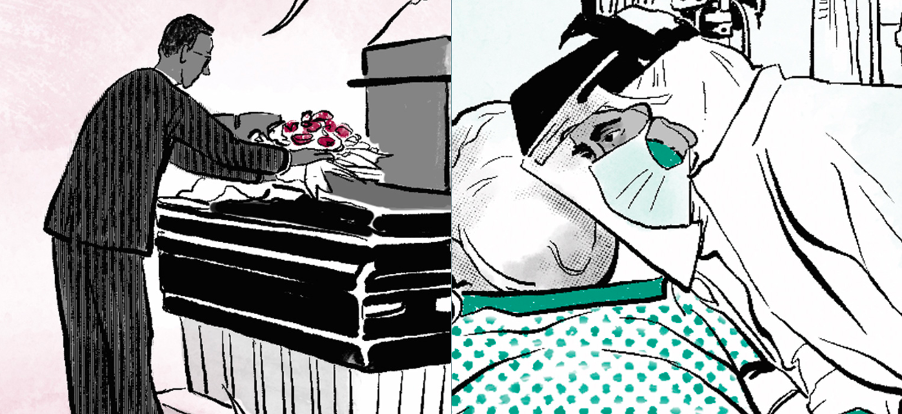
Figure 1: Detail from the front cover of the publication. In/Vulnerable: Inequity in the Time of Pandemic. 2020.
The collective nature of this formal approach—including the subjects’ cocreation through the contribution of their own audio diaries and video footage—becomes especially important because it makes more sense to work together when attempting to represent such a huge national and international phenomenon, affecting so many people’s lives. At the same time, there is a tension between the collective and the individual running throughout In/Vulnerable. It first appeared in weekly serial instalments, inevitably affecting how it was consumed and understood since, as Matthew Pethers has noted, “the ‘instalment’ [works] as a semi-autonomous narrative unit” (46). Thus, each individual weekly story can also be read on its own terms and heterodiegetic “voiceover” is kept to a minimum, arguably to preserve the autonomy and authority of each interviewee’s voice. Every digital instalment or graphic “episode” therefore offers a specific reflection of the social, economic, regional, and affective impacts of the pandemic on a particular American. As Margaret Peacock and Erik L. Petersen contend, “no one could describe a singular ‘American experience of 2020’” (x), and In/Vulnerable accordingly represents each subject as highly distinct in social, ethnic, racial, economic and geographical terms.
As Laura Robinson and others observed, “many vulnerable populations are bearing a disproportionate share of the costs of COVID-19 […] the unequal effects of the pandemic […] reverberating along pre-existing fault lines and creating new ones” (1603). For readers of Reveal and The Nib, the cumulative effect of viewing each weekly instalment of this series—as the pandemic was happening in its first year—must have had an incremental impact in exposing and charting major and urgent national divisions. Since graphic narrative is a sequential form, it is important to read In/Vulnerable as the sum of its documentary parts: that is, as a national representation, too. The editors of In/Vulnerable recall that they “wanted to create a comic series that would illuminate how a country that thought itself invulnerable began to learn what vulnerability really means and how unevenly that vulnerability is distributed. The goal of the comics was to capture what the pandemic has revealed: how precarious life is when there is no safety net” (In/Vulnerable 36).
The claim that, post-9/11, America could ever again have “thought itself invulnerable” may initially seem questionable. Yet this point cannot be divorced from the ongoing hubris of Donald Trump and his Make American Great Again supporters, in this case during his first Presidency from 2017–21. It can also be connected to the more affluent, insular, white subjects interviewed in In/Vulnerable: a small group of people here, who are given the space to speak their COVID truth in a bid for journalistic balance. Their sense of relative invulnerability is expressed in material terms through the physical distance afforded by underground bunkers and out-of-town properties.
By splitting the word “invulnerable” through the use of a forward slash, both “invulnerable” and “vulnerable” are contested and opened up to fresh interpretation, forcing us to look at these words anew and reinterrogate them both. This choice of title, then, foregrounds the editors’ provocation to consider “what vulnerability really means” by gesturing towards the recurring, interrelated, recursive themes of the graphic narrative overall: socioeconomic inequality versus privilege, precarious labour, migration, limited rights under the law, and a corporate and state disregard for human life through a failure to provide proper anti-COVID protection. In their introduction, the producers of In/Vulnerable note that when “the COVID-19 pandemic hit the United States […] millions of people [were] living paycheck to paycheck, uninsured and unhoused, in a country that is home to the most billionaires in the world. In/Vulnerable captures the shared devastation of the pandemic […] Nearly 100,000 Americans died of COVID-19 during the months that we published the series” (4). The graphic narrative honours and commemorates some of these deaths. It also attests to Americans’ resilience and survival; and to the documentary power of narrative, testimony, and storytelling through individual voices and the agency achieved via such “participatory production” as the subjects’ own video and audio accounts of their lived experience (Kim 5).
As graphic reportage, In/Vulnerable grapples with the challenge of condensing whole interviews into just eight panels of minimal text, while striving to do justice to and make sense of many different iterations of pandemic life. Words thus carry a greater weight with the brevity of written text making the visual dimension of In/Vulnerable—or “Bui’s visual translations of the interviews” (Feng 64)—even more significant. She unites the series’ first-person accounts, making the invisible visible through art and colour as she boldly visualises the lives of ordinary people or “undistinguished Americans”, in Hamilton Holt’s phrase, to render them specific and even extraordinary. In a work that contests the wider social erasure of many of its subjects and shows the potential of “graphic narratives [to] illuminate the systematic operations of racial, class, and gender inequality inside […] the United States” (Feng 59), that visibilising technique also invokes the graphic narrative’s title since “in/vulnerable” bears a homonymic resemblance to “invisible”.
The popular, accessible, and nonhierarchical comics form with its central relationship between text and image is combined here with a striking use of juxtaposition and a refusal to look away from some of the most harrowing effects of COVID-19 by focusing explicitly on incarceration, the daily exposure to contagion endured by medical and service industry professionals, a spike in racist violence, and death. In/Vulnerable thus demonstrates that graphic storytelling is an especially effective and democratic way of documenting new situations and experiences. As J. Maggio has argued,
the iconography of comics and cartoons is supportive of a kind of pluralistic democratic
individualism […] comics—as opposed to many other narrative visual art-forms—leave a large cognitive space for the viewer/reader to interpret their meaning […] the art of cartooning and/or comics […] helps create a subversive way of understanding the
world […] extremely well suited for democratic society, which continuously re-evaluates its own ethical positions […] based on cognitive freedom and self-creation. (237–38)As Robert Petersen has noted, moreover, the comics form is also a particularly valuable “vehicle for emotional empathy” (qtd. in Ty 3).
In this article, I will build on such notions of “cognitive freedom” (Maggio 238) and the power of graphic journalism to “solicit the reader’s compassion” (Rifkind 319) by offering the first sustained scholarly discussion of In/Vulnerable and focusing on the centrality of Bui’s formal contribution by addressing her use of colour. This particular analytical lens is necessary because she individualises and reveals the documentary “truth” of each story through a distinct chromatic language, employing often intense values or shades of specific primary, secondary and tertiary hues: blue, red, yellow, green, purple, and brown (O’Connor 839). Hence, I will emphasise this aesthetic technique—and its conjunction with narrative voice and the reader-text relationship—because “polychromatic graphic storytelling” (Baetens 115) is key to interpreting and understanding the themes of In/Vulnerable. Jan Baetens has argued that “color is undoubtedly one of the most underdiscussed and undertheorized features of comics and graphic novel scholarship. It is both everywhere […] and nowhere” (111). Writing in 2011, he was interrogating a traditional cultural association of colour with mass-produced “comic books” as opposed to “graphic novels, the more ‘distinguished’ form of comic art [which] tend to be in black in [sic] white” (Baetens 112). The role of colour in graphic narratives remains relatively overlooked in critical terms. I therefore confront that lacuna here through the example of In/Vulnerable, first by exploring Bui’s conjunction of colour with politico-economic inequality and then by considering the chromatic intersections (both implicit and explicit) between disability, care work, and death, which are depicted as largely racialised experiences during the COVID era. I will also look at the interplay between presence and absence and the use of frames to reflect the “contraction of space” (Joshi and Venkatesan) and a “cellular self” (Rifkind 329) compelled by COVID restrictions.
Representing Economic and Political Inequity Through Colour
Bui’s powerfully granular aesthetic and deeply compassionate vision draw from her own history as a minoritised American, beautifully and unforgettably chronicled in her critically lauded graphic memoir The Best We Could Do (2017) about her family’s experience of war, poverty, and migration from Vietnam to America in the 1970s. While the editors of In/Vulnerable were responsible for the selection of the fifteen subjects and strove for journalistic objectivity, their political position and drive for social justice—the “rhetorical” purpose of this pandemic documentary (Leuthold 56–57)—were thus clearly in line with Bui’s views as demonstrated by her earlier work. Her shifting chromatic palette reveals her respect for both the diversity and common humanity of COVID experience and exemplifies the power of colour to evoke particular moods, emotions, and themes, notably of oppression and inequality. As Charles Bramesco has argued in a cinematic context, “even with something as subtle and aesthetically pure as colour, there’s still an embedded politics” (8). Seen together, the fifteen segments of In/Vulnerable “form a multicolored quilt” (Green and Wall 2471) with Bui’s chromatic language offering a notable contrast to other COVID graphic narratives’ use of black and white to reflect the emptiness of “prolonged confinement” during the pandemic (Joshi and Venkatesan).
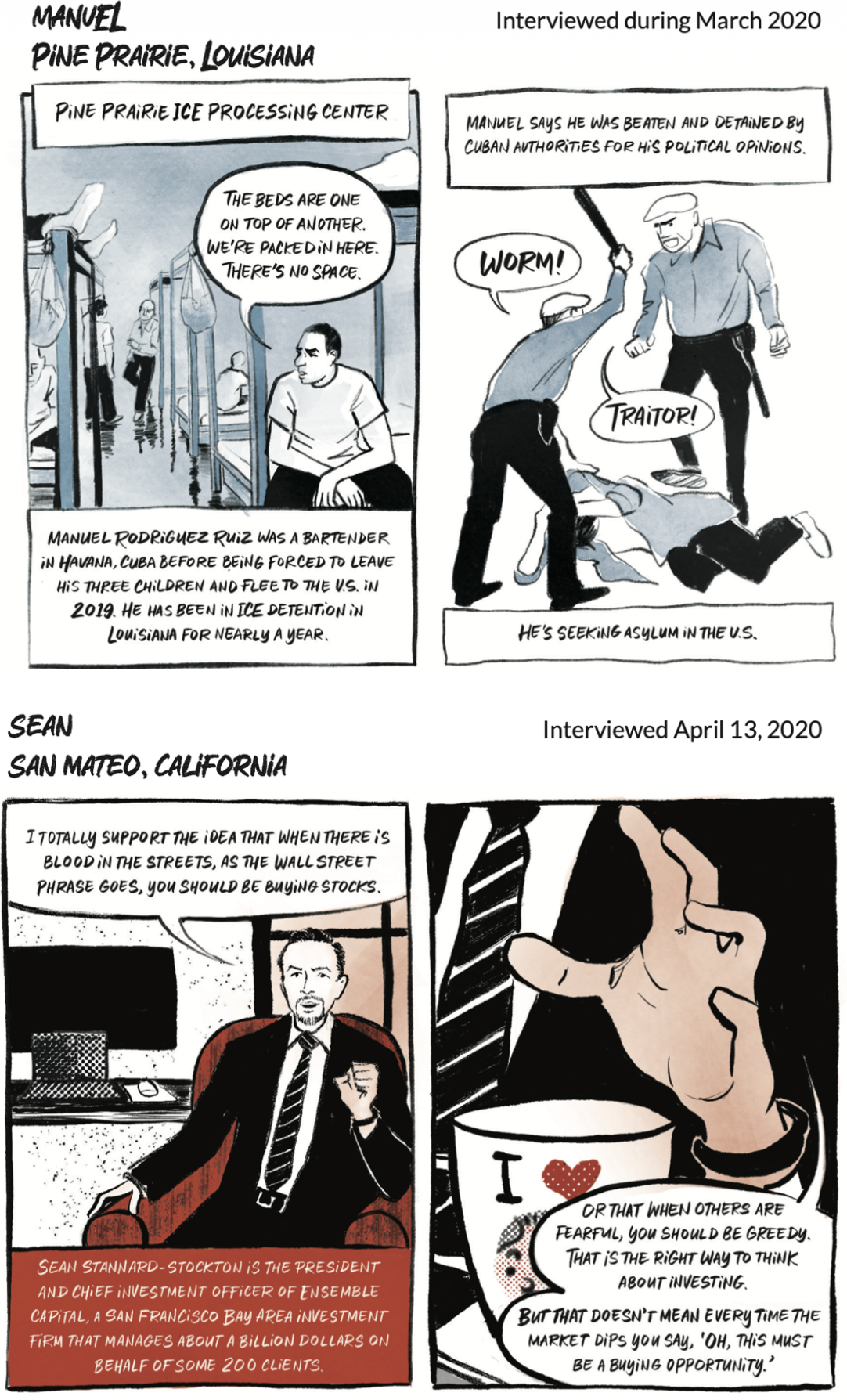
In the first narrative, Bui works in a muted, sombre, melancholic blue-grey to represent Manuel Rodriguez Ruiz, a Cuban political refugee faced with the intensely bleak experience of being criminalised and incarcerated in a US Immigration and Customs Enforcement (ICE) facility in Louisiana, a densely populated space with no anti-COVID protective measures in place. Referring to the ICE facility as “hell” and “a ticking time bomb” for COVID (In/Vulnerable 6), Manuel looks directly at the reader/viewer in a large close-up image, expressing his message in the first-person plural through a tricolon—“We’re desperate, we’re trapped, we’re not independent”—before moving to the question: “What will happen to us?” (6). Manuel is forced to exist in a liminal state of social death in a striking contemporary embodiment of what Achille Mbembe has termed “necropower”: how sovereignty is exercised through the capacity to dictate “who is disposable and who is not” (79–80). He speaks for his fellow ICE detainees as he boldly addresses the audience of Reveal, The Nib, and then In/Vulnerable: “we depend on you to give us the hygienic items to be able to clean ourselves in the bunker. We depend on you” (In/Vulnerable 6). Breaking the fourth wall, he harnesses the power of documentary to speak to “the viewer primarily as a citizen, member of civil society” (Michael Chanan qtd. in Kim 22; see also Rifkind 320).
Figures 2 (above) and 3 (below): Melancholic blue-grey contrasts with blood red.
In/Vulnerable: Inequity in the Time of Pandemic. 2020.
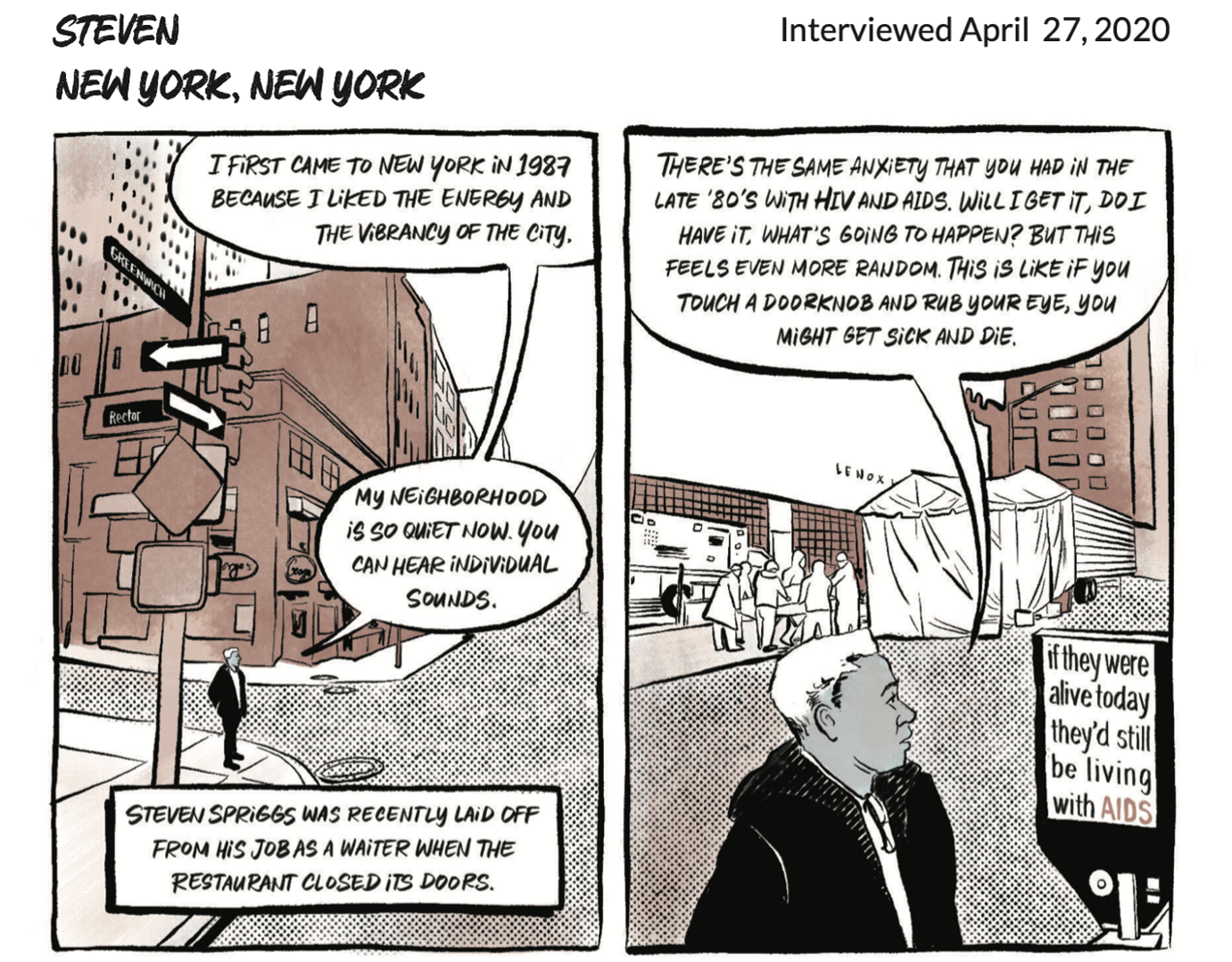
Recalling the power of film editing, it is a stark contrast to move immediately from the blue-grey hue of Manuel’s despair to the gilded privilege of Sean Stannard-Stockton, the bullish white president of a capital investment firm in San Francisco’s Bay Area (Narrative 2). His wealthy clients might as well be living in a country other than the “topographies of cruelty” Manuel is forced to endure (Mbembe 92). For Sean’s story, Bui uses a rich tomato red, along with pink and black, linking the repetition of red in the third panel to the stripes of the American flag. This colour choice suggests energy and movement, but also blood: an economic life blood being drained from many impoverished Americans to enrich the affluent elite which Sean represents and even implying metaphorical blood on his hands and those of his plutocratic clients. Throughout In/Vulnerable, there is an unmistakable implication that the privilege of certain Americans is bought at the expense of others.Moving ahead to Narrative 6, In/Vulnerable explores further politico-economic inequalities through the story of Steven Spriggs. A New York waiter of colour, he is suddenly facing unemployment in early 2020 when the midtown Manhattan restaurant where he has worked for twenty years is forced to close. Steven thus symbolises the innumerable Americans, especially those working in the service industry, whose livelihoods were disastrously impacted by COVID (for further contextualisation, see Peacock and Petersen 48). The uncertainty, emptiness and precarity that he feels following his redundancy—as distinct from Sean’s rapacious, self-enriching response to the pandemic—are mirrored by the dull shade of brown that fills his panels. This brown may also connote the colour of many New York buildings, a metropolitan, brownstone architecture which looms large in most of Steven’s panels, implying the ways in which (brown) citizens like him have been overwhelmed, overlooked, and left increasingly vulnerable by an uncaring government and society at both local and national levels. Steven also connects COVID to epidemics he has already lived through: “there’s the same anxiety you had in the late ’80s with HIV and AIDS. Will I get it, do I have it, what’s going to happen?” (In/Vulnerable 16). Although he has survived that particular health crisis, he is still tormented by multiple unanswered questions, encapsulated in a rapid tricolon that recalls the one used in Manuel’s opening narrative but this time in an isolated “I” voice. This fraught questioning (“will I […] do I […] what’s going to happen?”) concludes Steven’s section through the final speech bubble where, from his vantage point in late April 2020, he asks, “what if I’m still out of work come July when my unemployment runs out? [...] What do I do?” (In/Vulnerable 17). That last question is frantically repeated twice more, underscoring its urgency and the particular challenges and lack of resolution imposed by COVID on Americans like Steven.
Connecting to his experience is the COVID journey of another restaurateur, Billy Chiu, working in his family’s Chinese restaurant in San Francisco (In/Vulnerable Narrative 7). To visually narrate this story, Bui deploys a bright scarlet. Red is often linked with good fortune in Chinese culture: “auspicious—associated with life-generating energy (the sun, blood, and fire)—and […] the color of celebrations and prosperity” (“Red”). Hence its use here appears, on the one hand, to be culturally appropriate. But it is also potentially jarring. Billy, looking directly at the reader/viewer, is candid about calamitously falling business and the very real threat of Sinophobic hatred from other, non-Asian Americans. In the novel Joan Is Okay (2022), Weike Wang depicts the unfolding of COVID in America in early 2020, writing of “Asian people being attacked in the street and on the subways. Being kicked, pushed, and spat on for wearing masks and being accused of having brought nothing else into the country except disease” (195). This virulent response directly followed Trump’s scapegoating rhetoric of the so-called “Chinese virus” (“Trump”; see also Peacock and Petersen 38). As Billy puts it, “you’re like, ‘whoa, wait, what are they calling it?’ That was the troubling moment for me personally […] It’s hard enough to run a restaurant. The upsetting thing is the feeling of […] being a potential target for violence or death” (In/Vulnerable 18–19).
Figure 4: Brown connotes the New York urban landscape and the precarity of workers of colour like Steven. In/Vulnerable: Inequity in the Time of Pandemic. 2020.
Against this backdrop of “the kung flu” (Wang 195), with its wider global reverberations for “Asian peoples—not just Asian Americans” (Feng 64), why does Bui employ such a visually vivid colour? For one thing, this bright shade of red marks the Chiu family’s resilience and staying power.[3] Chinese American history dates back to the mid-nineteenth century with San Francisco, where Billy grew up, a particularly important and well-established centre for the community.[4] His narrative sits at the heart of In/Vulnerable, emphasising that—despite their long history in the United States—Asian Americans urgently need to make their voices heard during this racialised pandemic. Related to the violence Billy fears and Wang delineates in Joan Is Okay, the use of red also, once again, carries hematic associations: in anticipation of the violent or sacrificial spilling of Asian American blood—thus recalling Sean’s narrative, also set in the San Francisco area, and Bui’s own ethno-racial status—but also the notion of lifeblood and Billy’s own “spirit of hope” (Feng 64). As he puts it, “a restaurant is a living, breathing part of the community. It’s more than just feeding people […] That’s the beautiful thing about food. Whoever racist comes to San Francisco—they can walk in the door and you can change their perception” (In/Vulnerable 19).
The succeeding two stories are both about Texans. In Narrative 8, Gary Lynch, a white businessman, reveals the protection afforded by his luxury bunkers, an idea which creates further dissonance following the sections devoted to Steven and Billy and in its position just before Narrative 9, about an unnamed, young Texan woman of colour having to seek an abortion out of state. For Gary’s panels, Bui employs a dreamlike colour nuance of light green and implies that the bunkers—as distinct from the overcrowded, carceral, ICE “bunker” of contagion that Manuel highlights (In/Vulnerable 6)—are a privileged space principally available to white people, as illustrated by a 1950s-style nuclear family. This “nuclear” association also metonymically calls to mind the Cold War era with its bunkers constructed in readiness for the atomic threat, an idea which Gary recognises when he observes that “for years, people thought about a bomb shelter as a cold, dark, clammy place” (In/Vulnerable 20). Despite the sense of unreality his bunkers embody and their exorbitant cost—“prices start at $39,000 for a mini-bunker and go up to the palatial $8.3 million aristocrat” (In/Vulnerable 20)—Gary employs a self-justificatory and syllogistic reasoning to present these places as a kind of foregone conclusion indispensable for the public good: “if there is an economic problem then you’re going to see social and civil unrest […] That’s what people are really protecting themselves from […] without a bunker […] your neighbor, he’s going to kill you for a can of green beans to feed his kids […] what I do saves lives” (In/Vulnerable 21; see also Mbembe 88).
Following this stark depiction of white privilege and the power and protection it affords in the midst of a global pandemic, the tale of a college student (Narrative 9), simply named Jane Doe here, provides a decisive jolt. Her story, taken from a court document and dramatically presented in bright blue, is of the state’s failure to allow her an abortion at under ten weeks, after Texas Governor Greg Abbott’s decision to end “abortions in the state, claiming that medical supplies needed to be saved for other patients” (In/Vulnerable 22). When she is forced instead to undertake the risky twelve-hour journey to Colorado to undergo the termination, her home state almost becomes a character: “I feel like Texas put me in danger” (In/Vulnerable 23). This narrative employs a similarly interrogative mode to Steven, Billy, and Manuel, whose story is also presented through the colour blue. But when Jane Doe asks questions, they are also distinctly gendered: “Why is my life not important enough to the governor and the other men making these decisions?” (In/Vulnerable 23; emphasis added). Since questions, usually open, signal heightened personal and political vulnerability in this text, Sean’s only enquiry—“how do you explain what a trillion dollars is?” (In/Vulnerable 9)—is all the more revealing of the faultlines that In/Vulnerable exposes in its rhetorical purpose as a work of pandemic documentary.
Bui depicts three further white subjects in the text: Martha Marx (Narrative 5, discussed in the next section); Jamison Williams, a libertarian anti-lockdown protestor from North Carolina (Narrative 10); and Sherry Jenks, an estate agent renting luxury properties in the Hamptons to wealthy white New Yorkers (Narrative 14). Jamison—who has lost his job at a water filtration company forced to close in the pandemic, leaving “me and everybody I worked with without any income whatsoever”—sees lockdown in purely economic terms as “a state of tyranny” (In/Vulnerable 24). Speaking in late April 2020, he claims that “more people […] have lost their livelihoods than have gotten sick from coronavirus” (In/Vulnerable 25). Mostly set in outdoor spaces, his panels are coloured in light forest green, creating an interreferential connection with the green of Gary’s narrative and suggesting the ways in which, like many white American men, Jamison naturalises his particular worldview. Even as In/Vulnerable is less concerned with the lockdown and domestic cabin fever experienced by so many people in 2020, the colour green here reflects the longing for physical freedom offered by nature and fresh air and denied by COVID restrictions or “the great confinement, being told to stay at home and follow social distancing rules” (Crawford and Crawford 3).
Like Gary and his bunkers, Sherry sees the pandemic in terms of “shelter” (In/Vulnerable 33) and a guiltlessly commercial need to fulfil a certain kind of supply and demand for property. Her clients are shown in one panel as fleeing a pandemic-riven New York City and the Black Lives Matter street protests that we witness earlier in In/Vulnerable (in Narrative 11, which I will consider in the next section). These protestors’ right to demonstrate against racialised police brutality is reductively reinterpreted as Sherry’s (white) clients “looking to leave the city because of fear regarding protests” (In/Vulnerable 33). The synthetic lilac colour that Bui uses to illustrate Sherry’s narrative subtly evokes, and once again critiques, a part of society that has focused on its own needs rather than making any meaningful contribution or intervention to help more vulnerable people. Hence Peacock and Petersen argue that
three historical factors […] made America sicker than we should have been in 2020 […]
entrenched racial hierarchies […] an economic structure dependent on individual accumulation of wealth and […] cognitive dissonance, and an intentional historical amnesia that prevented the majority of comfortable […] middle-class, white Americans […] from doing anything about the first two issues […] disease is social and cultural as well as biological. (xii)There is indeed a sense of unreality and “cognitive dissonance” about the shade of purple used by Bui to depict Sherry. It is quite distinct from other hues and values employed throughout the graphic narrative, just as the high-end properties she rents do not reflect the realities of COVID for most Americans. As one of only five white Americans in the text, she is not shown to embody the majority pandemic experience.
Disability, Race, Care Work, and COVID Through a Chromatic Lens
Connected to this relationship between whiteness and glaring economic inequality are the ideas of disability and care work, mortality and racialised difference which are structurally and thematically central to In/Vulnerable and rendered visually through a chromatic specificity. Paul Crawford and Jamie Orion Crawford note “the disproportionate impact of coronavirus on communities of colour […] Particularly badly affected are vulnerable populations […] healthcare workers […] those on low incomes or with pre-existing conditions” (19). How are such themes, often interrelated and threaded through In/Vulnerable, explored aesthetically through notions of presence and absence and particular colour choices within Bui’s graphic documentary frames? When she depicts Sarah Alli-Brown, an African American high school student in Chicago (Narrative 3), aged around 16 or 17—an “11th grader busily studying for the S.A.T. when her school closed” (In/Vulnerable 10)—Bui opts for vivid yellows and ochres. In place of her mother, who is working “two jobs as a home health aide” (In/Vulnerable 10), Sarah must take care of her eight-year-old twin brothers, Emmanuel and Samuel, who has autism. She acknowledges the daunting sense of responsibility she feels for her family and her future, confessing that “I can’t stop because everyone depends on me” (In/Vulnerable 11). Traditionally, the colour yellow has often been negatively conceived, for instance, in association with “illness and cynicism” (Maxey 88; for a well-known literary example, see Gilman). This idea would certainly not be out of place in COVID times. Yet here the selection of yellow implies the warm hope and resilience that drive Sarah to continue studying and supporting others. Her youth perhaps accounts for some of her energy and sense of purpose. Despite ongoing uncertainty, particularly about her dream of going to college, Sarah’s narrative ends with a projected post-pandemic future in which she will tell her brothers how she cared for them, yet “‘still made it […] and overcame’ […] I know I can do it” (In/Vulnerable 11).
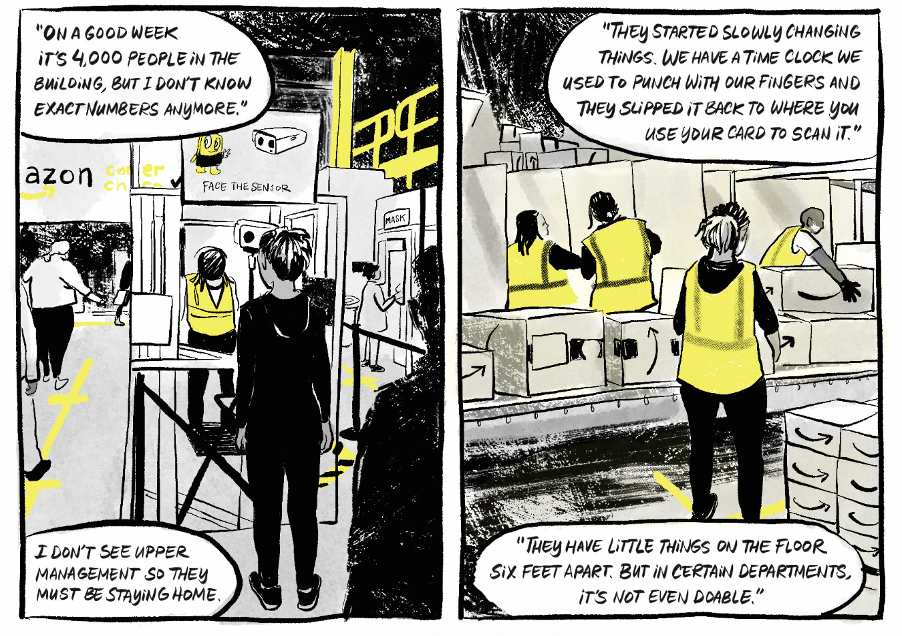
The theme of disability introduced, but not elaborated upon, in Sarah’s story is immediately continued in Zenobia Shepherd’s succeeding narrative where it is presented in a markedly different way. Through the use of light, bright blue paired with black, Zenobia’s pandemic experience is dominated by the untimely loss of her daughter Leilani Jordan, a kind and gregarious Black retail worker with special needs, exposed to COVID without any kind of protection on her shopfloor at a branch of supermarket chain Giant in Maryland. This story thus links to the later account of B., an anonymous woman of colour and Amazon warehouse worker in Staten Island (Narrative 12), who is cinematically framed against the Statue of Liberty in her opening panel: notably, however, the monument has its back to her as though to reinforce the notion that the promises of America do not apply to her. For B.’s narrative, Bui employs the bright yellow of high-visibility workwear. Although this chromatic decision initially suggests an interreferential link to Sarah’s story, yellow carries a very different meaning here. A colder, more citrus shade than the ochre yellow of Sarah’s narrative, it cannot be disentangled from Amazon’s use of yellow in its corporate branding and from the working environment by which B. is both trapped and exclusively defined. Like Giant in Zenobia’s story, Amazon is indicted for failing to protect staff in its overcrowded depots, despite its public rhetoric. Such an emphasis on professional negligence and a failed duty of care circles the reader/viewer back to the closed space and fears of COVID exposure in the ICE facility of Manuel’s opening narrative. As B. puts it, this “environment [is] great for the disease […] on a good week it’s 4,000 people in the building […] We’re not treated like people. We’re numbers” (In/Vulnerable 28–29). Ishani Anwesha Joshi and Sathyarak Venkatesan correctly observe that Bui “conveys a sense of this overcrowding through […] densely populated panels [and a] densely packed page layout, confined story-space, and a deluge of information conveyed through numerous text balloons.” We never see B.’s face—like Lady Liberty, she has her back to the audience—and this detail suggests two ideas in particular: the urgent need, like Jane Doe, to protect her anonymity in a desperate bid for continued survival against a lack of protection from barbaric official and corporate forces; [5] but also the erasure of her individual identity and agency—an involuntary facelessness, which also reflects the use of masks in the pandemic—through the dangers and demands of her work.B. speaks of a dizzying number of COVID cases at the Amazon warehouse, where business has been fuelled by the “surge in demand for home delivery services” during lockdown (Joshi and Venkatesan). But it is Zenobia’s narrative which grapples head-on with the deadly impact of the pandemic since her daughter has already died at the time of writing and exists as a spectral absent presence in the text. Zenobia rightly protests the inhumanity of a society that somehow deems it “okay” for “someone [with] a condition of any kind […] to get coronavirus” (In/Vulnerable 13). Leilani’s “condition” is not specified, so what does Zenobia mean exactly? Her daughter’s learning disability? Or underlying medical needs that have been endangered by her public-facing job? She may of course mean both but—through the economy of a longer transcript reduced to brief text in just eight panels—the word “condition” is left open, arguably made more haunting through its ambiguity. What is quite unmistakable, however, is the endurance of Zenobia’s religious faith after her daughter’s preventable death at just twenty-seven. Addressing Leilani’s spirit in the final panel as a butterfly ascending into the sky, she alludes to her daughter’s early interest in these insects which simultaneously represent beauty and fragility. Bui’s choice of blue here is elegiac, recalling the chromatic elements of Manuel’s narrative and anticipating the later stories of Jane Doe and Tawanda (Narratives 9 and 11). Each of these tales recounts a form of loss but, in the context of Zenobia, the light teal blue Bui deploys also seems cerulean, even celestial. It is a special shade of blue for Zenobia’s story and Leilani’s life, ultimately suggesting the solace of Zenobia’s belief in a Christian afterlife. Hence she tells her daughter-as-butterfly that “God’s going to watch out for you. He’s going to take care of you” (In/Vulnerable 13).
Figure 5: B’s narrative employs bright yellow to evoke high-visibility workwear and corporate branding. In/Vulnerable: Inequity in the Time of Pandemic. 2020.
Zenobia’s soteriological response to the pandemic is further developed in Narrative 13, where Douglas Hawkins, a Black undertaker in South Carolina, explains his COVID experience. In the business for over thirty years, he is devastated by the challenges of remote funerals, social distancing and “blocked bereavement” (Crawford and Crawford 26), yet he is motivated to continue working by his unwavering Christian faith and sense of hope. As Douglas puts it, “I think people take for granted what funeral directors do. Although we bury the dead our job is also to bring a sense of caring to the living. I’m doing something to move this family from […] witnessing a death, to […] acceptance of that death and moving on […] This is what God has called me to do” (In/Vulnerable 30–31). Creating a visual connection to Sean and Billy—and thus the sense of COVID, once again, as a national experience—his unflinching story of death via the funeral industry is presented through a dark carnation red. As Bramesco argues, “colour[s] […] can mean whatever we want them to” (103) and red is, of course, polysemic, used here to suggest the interdependence of life and death or the notion that “we’re all made out of red” (68).
Moving back to Narrative 11, we witness a much angrier and less stoical reaction to death through the activist environment of Tawanda Jones, an African American “kindergarten teacher and mother of four” (In/Vulnerable 26). Her narrative begins with an exophoric reference to the murder of George Floyd in Minneapolis in May 2020 with Tawanda listening to the words “I can’t breathe!” from video footage on her daughter’s phone and recollecting that Floyd’s murder by a white police officer took “eight minutes, forty seconds […] It broke my heart in so many ways” (In/Vulnerable 26). This event is so pivotal and well known that Floyd’s name and image are only briefly referenced on the side of a car and as a laptop image in panels 4 and 5. Initially shielding at home because one of her children is asthmatic, Tawanda is later ready to expose herself to further contagion by participating in Black Lives Matter protests on the streets of Baltimore. Her campaigning, portrayed by Bui through a striking blend of cornflower-blue, dark grey and black and a powerful use of close-up, is also driven by the police murder of her brother, Tyrone West, in a traffic stop in Baltimore in 2013. In one of Tawanda’s panels, an omniscient narrator notes that “black Americans are dying of COVID-19 at 2½ times the rate of white Americans” (In/Vulnerable 26; see also Crawford and Crawford 19). This threat of death is thus explicitly racialised, literally presented through black letters on a white backdrop, recalling Zora Neale Hurston’s famous quotation, “I feel most colored when I am thrown against a sharp white background”, and its later use in Claudia Rankine’s 2014 mixed-media text Citizen: An American Lyric (22–23), which also vocally protests white police murders of unarmed Black boys and men. The allusion to Tyrone’s death in In/Vulnerable echoes Leilani’s demise in Narrative 4, too, in the sense of a nexus between race and mortality in the United States. That linkage extends here to Tawanda’s declaration that “they’re killing us. Even though I don’t wanna die from COVID-19, I’d rather die fighting for a cause trying to save people’s lives” (In/Vulnerable 27).
This circular connection between death, sacrifice, the disabling effects of COVID, and the fight for survival also relates to the impossible challenges faced by US healthcare professionals. Immediately following Zenobia’s tragic COVID story is Narrative 5: that of Martha Marx, a white district nurse in Connecticut with thirty-five years of experience. She explains her strong vocation to nurse others following her mother’s early death: “I couldn’t save my mom, so I was gonna save other people […] I will never stop being a nurse” (In/Vulnerable 14). But Martha is caught in a horrible moral trap. Determined to help her patients yet, with minimal personal protective equipment and “each domestic threshold […] a borderland of decisions and risk” (Crawford and Crawford 4), she is also terrified that she is spreading COVID to “some of the most fragile people in our community” (In/Vulnerable 14). For this narrative, Bui deploys a plum hue which is both eye-catching—with Martha in her deeper purple uniform standing out against a predominantly white, black or grey backdrop—and low-key through its lighter shades. Perhaps this contrast is deliberately intended to reflect the contradictory nature of Martha’s daily struggles where she is both saving lives and potentially endangering them. The paler plum colour even suggests a kind of twilight to signal a sense of suspended time and the end of life that Martha has witnessed, hopes not to bring to her patients, and will inevitably experience herself one day, telling her children to play John Prine’s mournful 1971 American country song, “‘Angel from Montgomery’ […] at my funeral” (In/Vulnerable 15). The notion of twilight could further imply that Martha inhabits a liminal ethical zone where, against scientific reason and her own better judgement, and recalling Leilani’s death, “infection control” is simply not taking place and she is forced to become part of the problem (In/Vulnerable 15).
This professional fight against COVID is later thematised through Dr Rajnish Jaiswal, an Indian American Emergency Room doctor in New York, whose story, coloured in the green of hospital scrubs, closes In/Vulnerable (Narrative 15). Rajnish is honest about the physical risks and emotional toll exacted by the overwhelming experience of treating COVID patients, including his colleague, a nurse, who was “gasping for air […] blue and gray […] slowly suffocating to death” (In/Vulnerable 35). Although Rajnish’s colleague survived, the “blue and gray” colours evoked here within the hospital context take us back to the opening of In/Vulnerable: the highly infectious, deadly environment of the Trump-mandated ICE facility in Manuel’s narrative. As Rajnish’s “fellow soldier”, the nurse also recalls Martha’s lived experience on the frontlines of COVID, where she is “out there every single day […] when everybody else doesn’t even go grocery shopping” (In/Vulnerable 35, 15). The first-hand accounts of Rajnish’s colleague and Sarah’s mother as a “home health aide” remain outside the narrative frame with the embedded testimonies of Martha and Rajnish instead revealing the perilous exposure of certain Americans to the full blast of the pandemic in 2020 (In/Vulnerable 10).
Conclusion
The critique offered by In/Vulnerable through the visual and verbal framing of real-life stories is clearly directed at the murderous inhumanity of a Trump-led white US political and legal establishment—from the President to Governor Abbott to the police in Baltimore and Minneapolis (to name just two US cities)—towards many ordinary people, especially Americans of colour. That In/Vulnerable ends with Rajnish and his desperate experiences as a medical professional brings the collection back to an undeniably harsh reality amid the longer-term impacts of COVID: the recovery process promising to be, in Rajnish’s final words, “a long journey” (In/Vulnerable 35). Gary and Sherry may hide away in bunkers and luxury, out-of-town properties, but the deadly message of In/Vulnerable is stark, persistent, and prominently marked through Bui’s visual language and “structural use of […] color” in terms of race, disability, class, and economic disparity (Baetens 118).
Her art examining pandemic-related questions of social justice, inequality, and isolation is still all too relevant. Thus, In/Vulnerable goes beyond its specific spatiotemporal framework and tapestry of competing COVID “truths” to illuminate the ongoing documentary potential of graphic narrative; the form’s powerful, yet still overlooked, imbrication with colour symbolism; and the democratic scope it offers more marginalised members of society through its agential possibilities for “participatory production” (Kim 5). We are still in the early stages of a “post”-pandemic time and sense-making texts about the events of 2020 will no doubt continue to appear. As an early example of pandemic documentary with its raw and immersive, first-hand, US-based accounts, In/Vulnerable occupies an important testimonial role in our process of acquiring more historical distance from the immediate effects and polyvalent trauma of COVID-19.
Notes
[1] The publication is now available as a free PDF which can be downloaded from the Reveal website via an online form (In/Vulnerable). I will refer to this edition throughout the following discussion.
[2] For further examples of COVID-19-related graphic narratives, see Michael J. Green and Shelley Wall, whose brief survey of “graphic medicine” in 2020 breaks texts down into “therapeutic comics”, “instructional comics”, and “personal stories” (2469–70; see also Joshi and Venkatesan).
[3] At the time of writing and according to its website, their restaurant is still in business in San Francisco’s Chinatown (Grant Place Restaurant).
[4] This idea is also illustrated through such popular cultural works as the Hollywood musical The Flower Drum Song (1961), directed by Henry Koster, and Wayne Wang’s independent movie Chan Is Missing (1982).
[5] Compare Candida Rifkind’s point that “cartoonists may be safer documentarians than photographers for people who need to hide their identities, yet have their experiences and existence made public” (318).
References
1. Baetens, Jan. “From Black & White to Color and Back: What Does It Mean (Not) to Use Color?” College Literature, vol. 38, no. 3, 2011, pp. 111–28, https://doi.org/10.1353/lit.2011.0027.
2. Bramesco, Charles. Colours of Film: The Story of Cinema in 50 Palettes. Frances Lincoln, 2023.
3. Bui, Thi. The Best We Could Do. Houghton Mifflin Harcourt, 2017.
4. Chute, Hillary L. Disaster Drawn: Visual Witness, Comics, and Documentary Form. The Belknap P of Harvard UP, 2016.
5. Crawford, Paul, and Jamie Orion Crawford. Cabin Fever: Surviving Lockdown in the Coronavirus Pandemic. Emerald Publishing, 2021.
6. Eitzen, Dirk. “When Is a Documentary? Documentary as a Mode of Reception.” Cinema Journal, vol. 35, no. 1, 1995, pp. 81–102, https://doi.org/10.2307/1225809.
7. Feng, Pin-Chia. “Graphic Matters: Teaching Asian American Studies with Graphic Narratives in Taiwan.” Journal of Transnational American Studies, 2022, pp. 59–72, https://doi.org/10.5070/T813259205.
8. Gilman, Charlotte Perkins. The Yellow Wallpaper. Virago, 1998.
9. Grant Place Restaurant. Grant Place Restaurant, www.grantplacerestaurant.com. Accessed 26 June 2025.
10. Green, Michael J., and Shelley Wall. “Graphic Medicine—The Best of 2020.” JAMA, vol. 324, no. 24, 2020, pp. 2469–71, https://10.1001/jama.2020.19479. Accessed 26 June 2025.
11. Holt, Hamilton. The Life Stories of Undistinguished Americans as Told by Themselves.1906. Routledge, 2000.
12. Hurston, Zora Neale. “How It Feels to Be Colored Me.” 1928. African American Poetry: A Digital Anthology by Amardeep Singh, 25 Nov. 2024, scalar.lehigh.edu/african- american-poetry-a-digital-anthology/zora-neale-hurston-how-it-feels-to-be-colored-me-1928. Accessed 26 June 2025.13. In/Vulnerable: Inequity in the Time of Pandemic. Illustrated by Thi Bui, series edited by Amanda Pike and Esther Kaplan, interviews by Reveal staff, adapted into comic scripts by Sarah Mirk, Reveal and The Nib, 2020, revealnews.org/in-vulnerable. PDF version.
14. Joshi, Ishani Anwesha, and Sathyaraj Venkatesan. “Regulated Pandemic Spaces: Spatial Crises in COVID Comics.” Journal of Medical Humanities, 10 July 2024, https://doi.org/10.1007/s10912-024-09864-y.
15. Kim, Jihoon. Documentary’s Expanded Fields. Oxford UP, 2022.
16. Koster, Henry, director. The Flower Drum Song. Universal-International, 1961.
17. Leuthold, Steve. “Rhetorical Dimensions of Native American Documentary.” Wicazo Sa Review, vol. 16, no. 2, 2001, pp. 55–73, https://doi.org/10.1353/wic.2001.0022.
18. Maggio, J. “Comics and Cartoons: A Democratic Art-Form.” PS: Political Science and Politics, vol. 40, no. 2, 2007, pp. 237–39, https://doi.org/10.1017/S1049096507070357.
19. Maxey, Ruth. “‘Beige Outlaws’: Hanif Kureishi, Miscegenation and Diasporic Experience.” Metaphor and Diaspora in Contemporary Writing, edited by Jonathan P. A. Sell, Palgrave Macmillan, 2012, pp. 80–98.
20. Mbembe, Achille. Necropolitics. Duke UP, 2019.
21. O’Connor, Zena. “Traditional Colour Theory: A Review.” Color Research and Application, vol. 46, no. 4, 2021, pp. 838–47, https://doi.org/10.1002/col.22609.
22. Peacock, Margaret, and Erik L. Petersen. A Deeper Sickness: Journal of America in the Pandemic Year. Beacon Press, 2022.23. Pethers, Matthew. “Serialization and the Narrative Scales of the Literary Magazine.” The Routledge Companion to the British and North American Literary Magazine, edited by Tim Lanzendörfer, Routledge, 2021, pp. 45–58.
24. Rankine, Claudia. Citizen: An American Lyric. Penguin, 2015.
25. “Red.” National Museum of Asian Art, 2025, https://asia.si.edu/explore-art-culture/art-stories/colors/red/#:~:text=In%20China%2C%20red%20is%20auspicious,with%20minor%20differences%20in%20detail. Accessed 26 June 2025.
26. Rifkind, Candida. “Migrant Detention Comics and the Aesthetic Technologies of Compassion.” Documenting Trauma in Comics: Traumatic Pasts, Embodied Histories, and Graphic Reportage, edited by Dominic Davies and Candida Rifkind, Palgrave, 2020, pp. 317–36.
27. Robinson, Laura, Jeremy Schulz, Massimo Ragnedda, Heloisa Pait, K. Hazel Kwon, and Aneka Khilnani. “An Unequal Pandemic: Vulnerability and COVID-19.” American Behavioral Scientist, vol. 65, no. 12, 2021, pp. 1603–07, https://doi.org/10.1177/00027642211003141.
28. Schlichting, Laura, and Johannes C. P. Schmid. “Introduction to Graphic Realities: Comics as Documentary, History, and Journalism.” ImageTexT, vol. 11, no. 1, 2019, imagetextjournal.com/introduction-to-graphic-realities-comics-as-documentary-history-and-journalism. Accessed 26 June 2025.29. “Trump angers Beijing with ‘Chinese Virus’ Tweet.” BBC News, 17 Mar. 2020, www.bbc.co.uk/news/world-asia-india-51928011. Accessed 26 June 2025.
30. Ty, Eleanor. “Introduction: Asian American Literature and Asian American Graphic Novels.” Beyond the Icon: Asian American Graphic Narratives, edited by Eleanor Ty, Ohio State UP, 2022, pp. 1–22.
30. Wang, Wayne, director. Chan Is Missing. International Film Bureau, 1982.
32. Wang, Weike. Joan Is Okay. Text Publishing, 2022.
Suggested Citation
Maxey, Ruth. “Pandemic Documentary and Graphic Narrative: Race, Disability, and the Chromatic Language of In/Vulnerable: Inequity in the Time of Pandemic.” Alphaville: Journal of Film and Screen Media, no. 31, 2026, pp. 17–32. DOI: https://doi.org/10.33178/alpha.31.02
Ruth Maxey is Associate Professor of Modern American Literature at the University of Nottingham. Author of South Asian Atlantic Literature, 1970-2010 (Edinburgh University Press, 2012) and Understanding Bharati Mukherjee (University of South Carolina Press, 2019; named a Choice Outstanding Academic Title 2021), she has edited 21st Century US Historical Fiction: Contemporary Responses to the Past (Palgrave, 2020) and The Collected Short Stories of Bharati Mukherjee (Temple University Press, 2023). She is coeditor (with Paul McGarr) of India at 70: Multidisciplinary Perspectives (Routledge, 2019) and (with Daniel King) of Power Plays in Transnational American Fiction: Gender, Race and Genre (Bloomsbury, 2026).